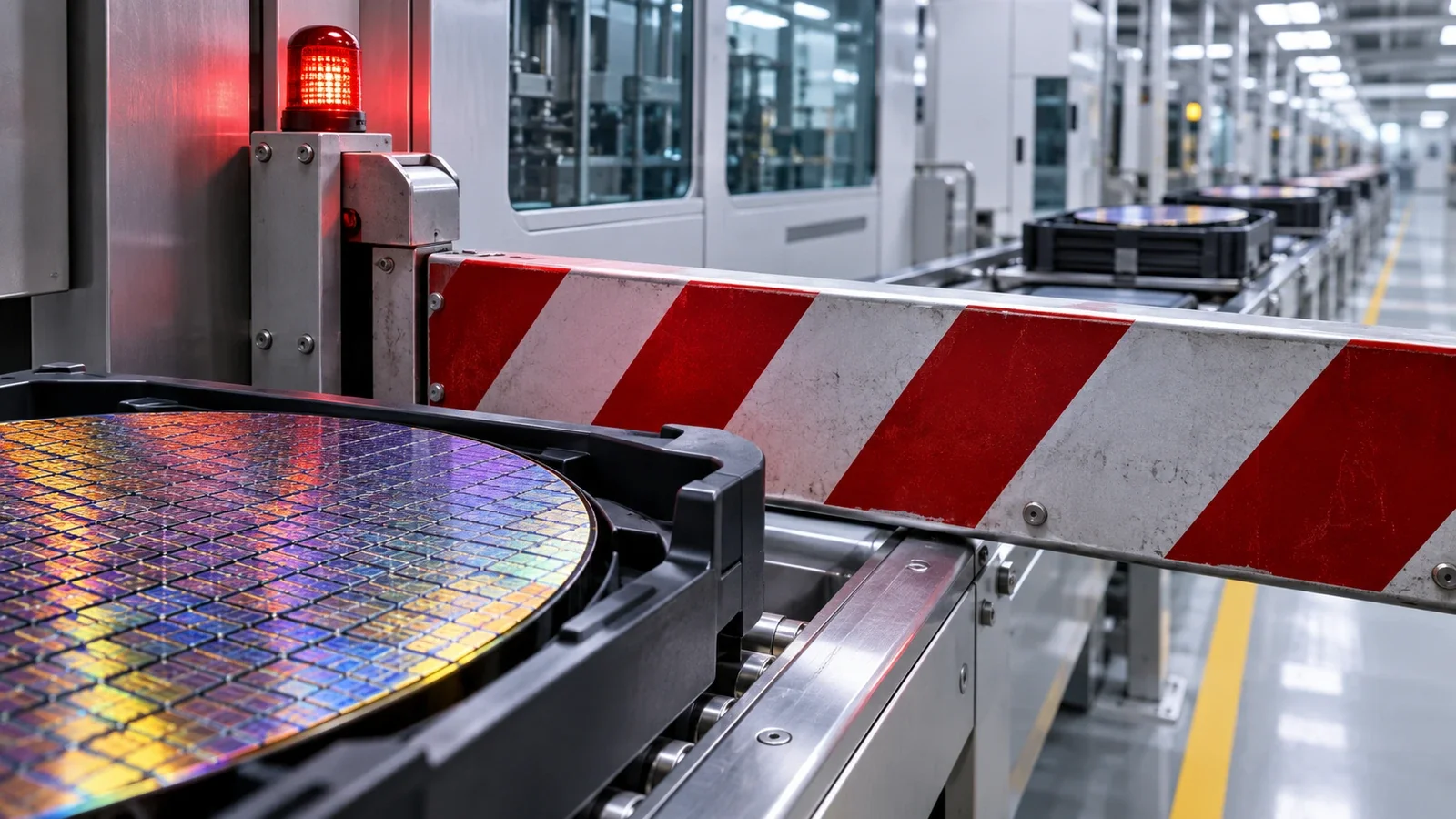
TSMC suspended manufacturing orders for advanced chips from certain Chinese customers, while Samsung halted part of its deliveries to the country after new United States restrictions took effect on Thursday (19). The measures affect one of the main alternatives used by Chinese companies to develop artificial intelligence processors outside their territory.
According to Reuters, TSMC instructed that orders involving manufacturing processes of 16 nanometers or smaller be halted, unless the customer obtains an American export license. Affected Chinese customers are generally limited to older technologies, of 28 and 40 nanometers, as long as their projects do not use high-bandwidth memory (HBM) or advanced packaging.
The TSMC and Samsung suspensions were first reported by the Financial Times, based on sources close to the operations. To Reuters, the Taiwanese manufacturer said it will comply with the new applicable regulatory requirements, but did not comment on the details of the orders.
Moonshot abandons US$ 150 million contract to access GPUs in Indonesia
One of the most concrete consequences emerged at Moonshot AI, the Chinese developer of the Kimi models. The company canceled a US$ 150 million contract that would give it access to a set of Nvidia Blackwell Ultra B300 GPUs installed in a data center in Indonesia, according to a report published by The Information on November 19.
The agreement had been signed with a Southeast Asian cloud computing provider and provided for the start of use of the processors in 2027. To secure the capacity, Moonshot reportedly agreed to advance approximately 50% of the contract value, against the roughly 15% normally required in similar agreements.
The report does not establish that the advance was actually disbursed or lost. The cancellation was also not publicly confirmed by Moonshot. Later reports indicate that the company had hired another regional supplier, without disclosing the terms of the new agreement.
The decision illustrates the difficulty created for Chinese companies that sought computing capacity in third countries, including through remote rental of servers.
Tencent expects delay in Hunyuan; Alibaba accelerates its own chips
The consequences also reached the planning of China's largest technology companies.
At the November 18 earnings presentation, Martin Lau, Tencent's president, acknowledged that the restrictions should increase the time needed to develop the next version of the Hunyuan model.
"This delays everyone in China", said Lau, according to Fortune. The company considers that domestic chips can meet a good part of its inference needs, but training more advanced models remains more exposed to capacity limitations.
Tencent reported quarterly revenue of 207.3 billion yuan, annual growth of 8%, while its operating profit fell 7%.
Alibaba, in turn, reported revenue of 271.5 billion yuan, up 10%. Its AI Cloud and Compute Services division grew 53%, to approximately 61 billion yuan.
Capital investments reached 50.5 billion yuan, an increase of 60% compared with the same quarter of 2025, although below the 67.7 billion recorded in the immediately previous quarter.
CEO Eddie Wu said that the next generation of Qwen is already being trained with the company's own processors from the T-Head division. The company expects that, after 2027, most of the additional AI chip capacity will come from domestic solutions.
Wu also acknowledged that American restrictions create uncertainty for the supply of computing capacity and may affect products and services in 2027.
The license requirement also reaches foundries and data centers abroad
The interim rule from the Bureau of Industry and Security (BIS), published in the Federal Register on November 19, expands controls on exports, reexports and transfers of advanced semiconductors.
The text requires licenses for certain chips sent to Indonesia, Malaysia, Singapore, Thailand and Brazil. It also reaches data centers in any country that provide more than 12 million aggregate units of processing performance (TPP) to companies based in China, Macau or other destinations covered by the restrictions.
Operators that already provided these services received 90 days to obtain authorization and continue their activities. License applications will be evaluated individually, and the rule provides for specific exceptions.
In manufacturing, the changes restrict the technical verification mechanisms that previously allowed certain Chinese designers to obtain advanced chips without individual licenses. The American list of previously approved designers includes Nvidia, AMD, Apple, MediaTek and Realtek, but no company from mainland China.
As a result, the controls no longer depend only on the physical destination of the processors. They now also reach those who manufacture the chips, those who contract the computing capacity and those who effectively use the servers abroad.