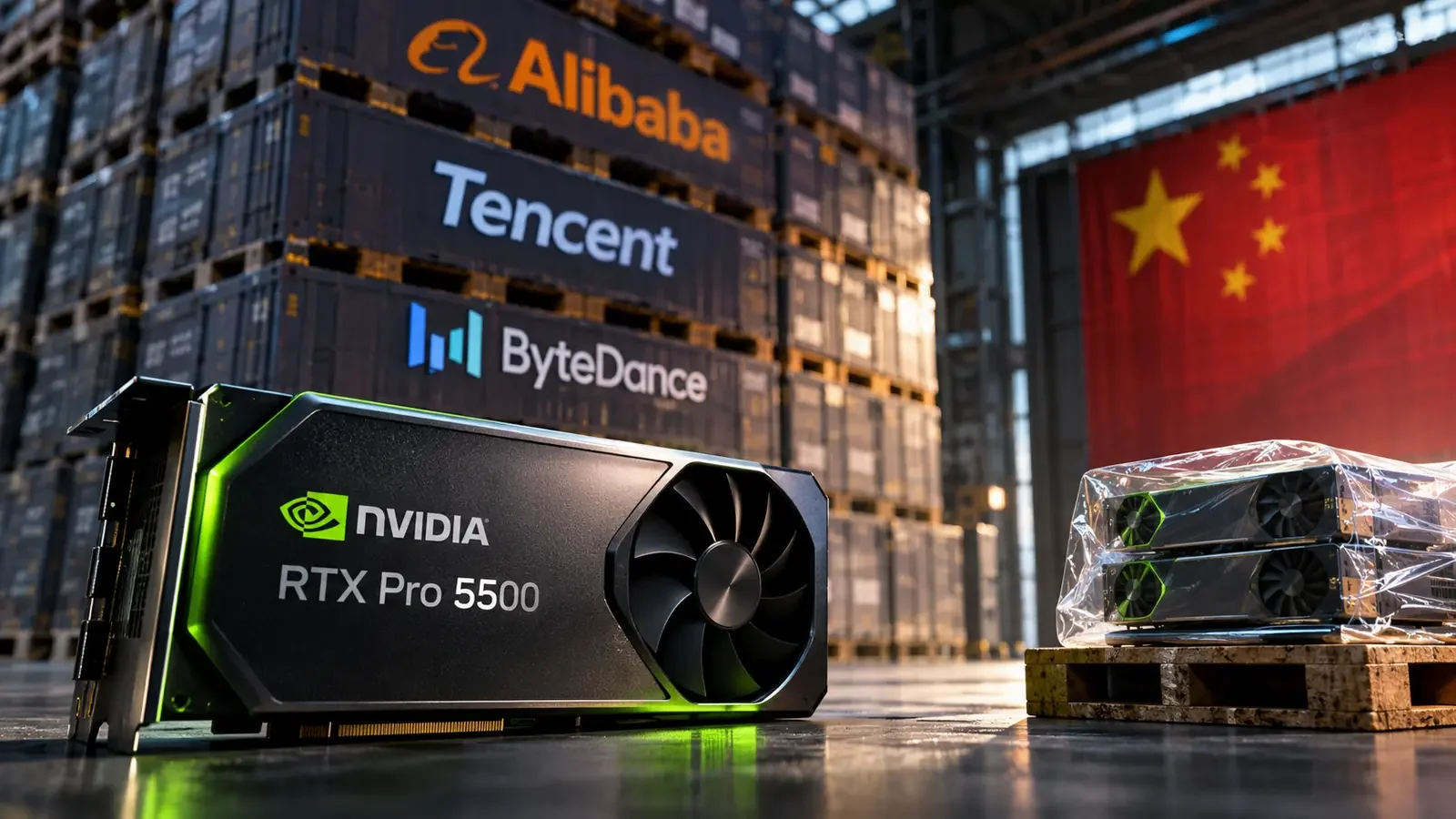
Alibaba, Tencent, ByteDance and other Chinese companies ordered about 6 million Nvidia RTX Pro 5500 chips, valued at approximately US$ 70 billion, but expect to receive only 1% of that volume over the next four months. The estimate was revealed by Bloomberg in a report published on November 4, based on sources familiar with the orders.
The companies estimate they will receive only a few tens of thousands of units in that period. Each chip costs more than US$ 11,000, but the total value of the orders represents potential demand, not revenue already realized by the American manufacturer.
The first batches are expected to include units in the thousands by December 2026, followed by tens of thousands in February 2027. According to Bloomberg, an internal projection from one of the main buyers indicates that cumulative deliveries could reach 700,000 chips by the end of 2027, still far below the 6 million requested.
The problem lies in Nvidia's production capacity, as it faces high global demand and prioritizes its most sophisticated and profitable processors. The company depends on Taiwanese manufacturer TSMC, whose capacity is also being directed to next-generation products, including the Rubin platform.
American restrictions make the RTX Pro 5500 an alternative for China
The RTX Pro 5500 uses the Blackwell architecture and was originally developed for professional workstations. Chinese companies intend to use it mainly for artificial intelligence inference, the process in which already-trained models perform tasks and generate responses.
Although less powerful than data center accelerators such as the B300, whose export to China is banned by the United States, the RTX Pro 5500 is not subject to the same restrictions. That has made it an alternative for Chinese companies that need to expand their computing capacity.
On October 20, Reuters had already reported that Alibaba, Tencent and ByteDance had requested more than 3 million units, valued at more than US$ 35 billion. At the time, sources reported that Nvidia could not guarantee full fulfillment of the orders.
The shortage also keeps pressure on Chinese suppliers such as Huawei, Cambricon and T-Head, Alibaba's semiconductor division. Despite technological advances, these companies face manufacturing limitations and difficulties obtaining advanced components.
Asked by Bloomberg, Nvidia did not confirm the projected delivery volumes. A spokesperson criticized both American export restrictions and the limits imposed by China on imports of US products. Alibaba, Tencent and ByteDance did not respond to the outlet's requests for comment.