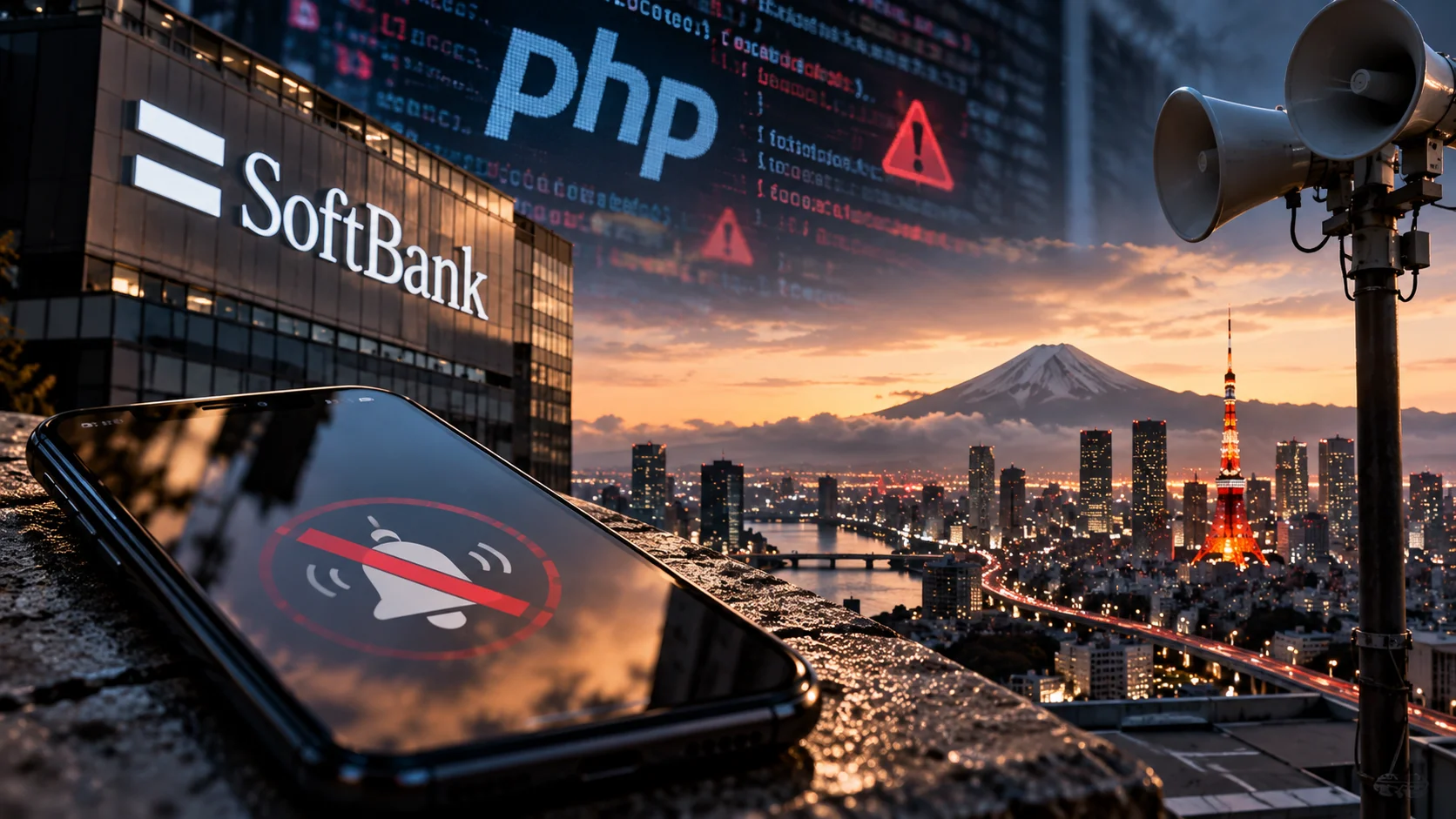
The Japanese carrier SoftBank suspended its mobile emergency alert system this Friday (23) while it carries out maintenance to fix critical vulnerabilities in PHP. The measure temporarily prevents this service from receiving warnings about earthquakes, tsunamis, and evacuation orders.
The interruption began at 6:47 local time, and is expected to last until Monday (26). In addition to SoftBank customers, the suspension affects users of the Y!mobile and LINEMO brands, according to announcements issued by Japanese municipal authorities.
During the maintenance, the carrier's system will not be able to distribute emergency notifications. Other channels remain available, including Yahoo's disaster alert app, municipal information services, and official communication platforms.
SoftBank has more than 30 million smartphone customers, but that number does not necessarily represent the number of people affected by the interruption. The suspension also does not mean that all of Japan's earthquake alert mechanisms are unavailable.
The episode comes after the disclosure of two critical vulnerabilities in PHP, a language widely used in servers and web applications. The flaws allow, under certain conditions, remote code execution without authentication. The developers published fixes on October 21 and recommended immediate updating.
The preventive response reached different sectors of the Japanese economy. According to Reuters, financial institutions such as Nomura and Mitsubishi UFJ Financial Group (MUFG), the airline ANA, and the railway operator JR East temporarily suspended certain digital services.
Public agencies, including the Ministry of Finance, the National Tax Agency, and the Japan Meteorological Agency, also reported disruptions. On Friday, JR East said that some services had been restored, while others awaited security checks.
The suspensions were adopted as protective measures and do not, by themselves, constitute evidence of successful intrusions into the systems involved.
Japan prepares team to simulate cyberattacks with artificial intelligence
Amid the disruptions, the Japanese government announced the creation of a team specialized in identifying vulnerabilities through simulated attacks. The group is to be organized by November, at the Information Technology Promotion Agency (IPA), a government-affiliated institution.
The initiative will bring together offensive security experts, known as ethical hackers, to carry out penetration tests and identify flaws before criminals can exploit them. The strategy also calls for the use of artificial intelligence in defense activities.
Minister of Economy, Trade and Industry Ryosei Akazawa explained the need to anticipate the actions of digital criminals.
“Defenders also need to use AI and act proactively, staying one step ahead”, he told Reuters.
The minister also said that the government had sent alerts about the PHP vulnerabilities to approximately one thousand industry associations on October 21, in addition to recommending the rapid application of the fixes.
The specialized team was not yet in operation when the announcement was made. Meanwhile, companies and public agencies continue working to update their systems and verify the conditions necessary to fully restore the suspended services.