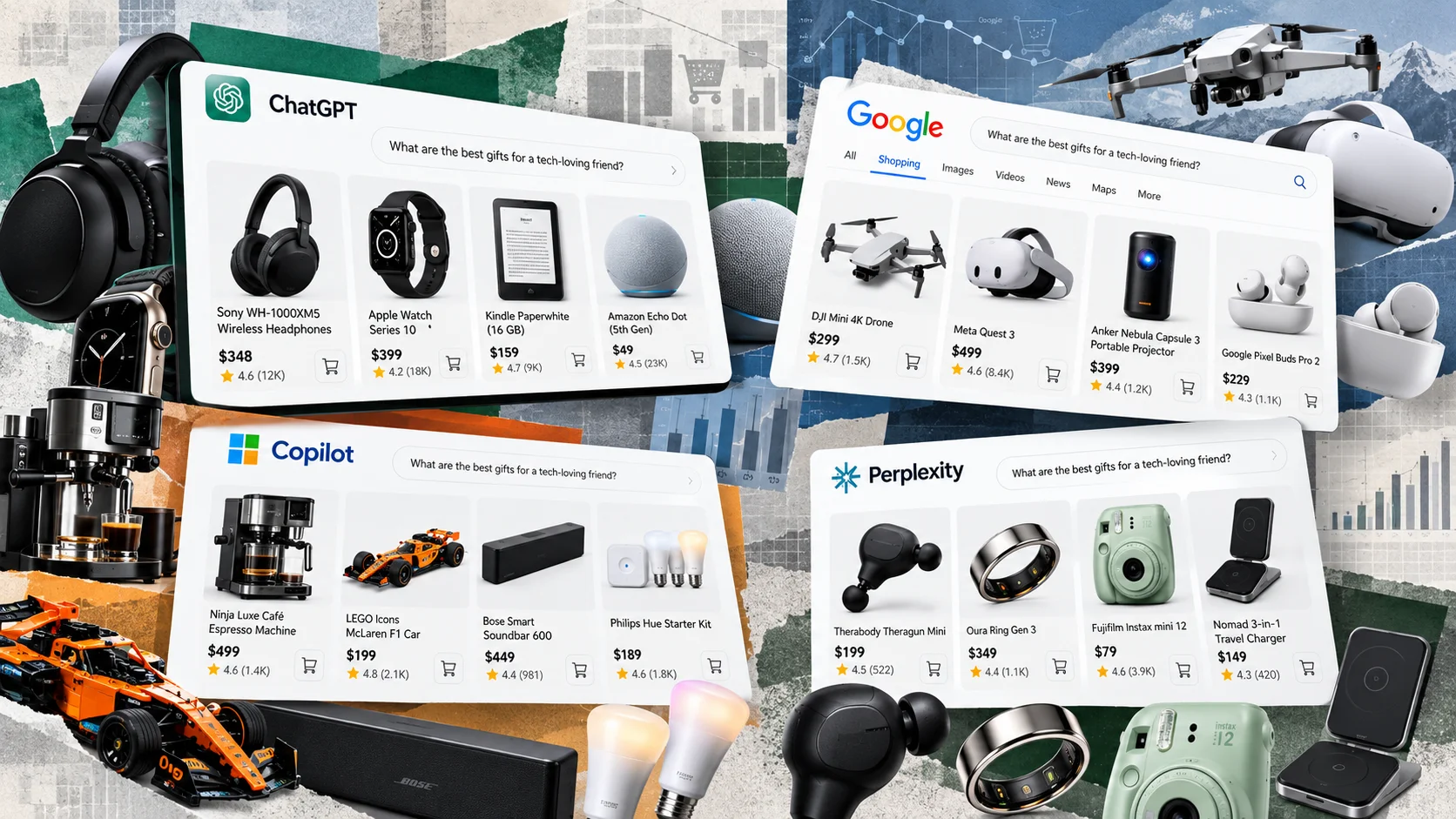
A survey released by AEOsome Research in October 2026 identified major differences in shopping recommendations from ChatGPT, Google AI Mode, Microsoft Copilot and Perplexity. Only 1.6% of the questions asked of the four assistants resulted in product cards being displayed on all platforms.
The survey analyzed 30,855 responses, divided between two experiments conducted in the first half. The main comparison gathered 22,335 responses across seven product categories, including electronics, beauty, health and household items.
The researchers counted as recommendations only structured cards that featured the product name, price and a link to a merchant. Brand mentions in the text were not included in the count.
In this set, the Google AI Mode displayed cards in 64.4% of responses, followed by Microsoft Copilot, with 44.5%, ChatGPT, with 28.5%, and Perplexity, with only 5%.
The difference reveals that the presence of products in responses depends heavily on the platform used, although the results also vary according to the type of question and the model responsible for the response.
Only 1.6% of questions displayed products across all four assistants
Among the 5,583 questions answered by all platforms, 21.9% did not produce cards in any of them, while 31.7% resulted in structured recommendations in only one assistant.
Even when two platforms displayed products, the selections rarely coincided. The overlap between specific products ranged from 1% to 5%, depending on the combination of assistants analyzed. For brands, the rate stood between 25% and 42%.
The study also identified differences in the stability of ChatGPT's responses. When repeating identical questions, the researchers observed that the presence or absence of cards changed in 42.4% of the pairs of responses.
Much of this variation was associated with the model used. When the same model answered both queries, there was agreement in 90.2% of cases. When the model changed, agreement fell to 25.5%.
This difference helps explain ChatGPT's aggregate result. The GPT-5.3 mini model, responsible for approximately 60% of the responses collected, displayed cards in only 3.7% of queries. Meanwhile, the GPT-5.5 and GPT-5.3 models recorded rates of 65.3% and 72.2%, respectively.
Thus, the 28.5% average does not represent ChatGPT's uniform behavior and must be interpreted considering the distribution of models during the tests.
The experiments were conducted in the United States, in English, between February and May 2026, using web interfaces without login. The results do not measure sales or conversions and do not allow determining whether the same behavior persists in the current versions of the assistants.
AEOsome, which also sells product visibility services in AI systems, published the methodology and limitations of the survey. The results presented do not have identified independent replication.