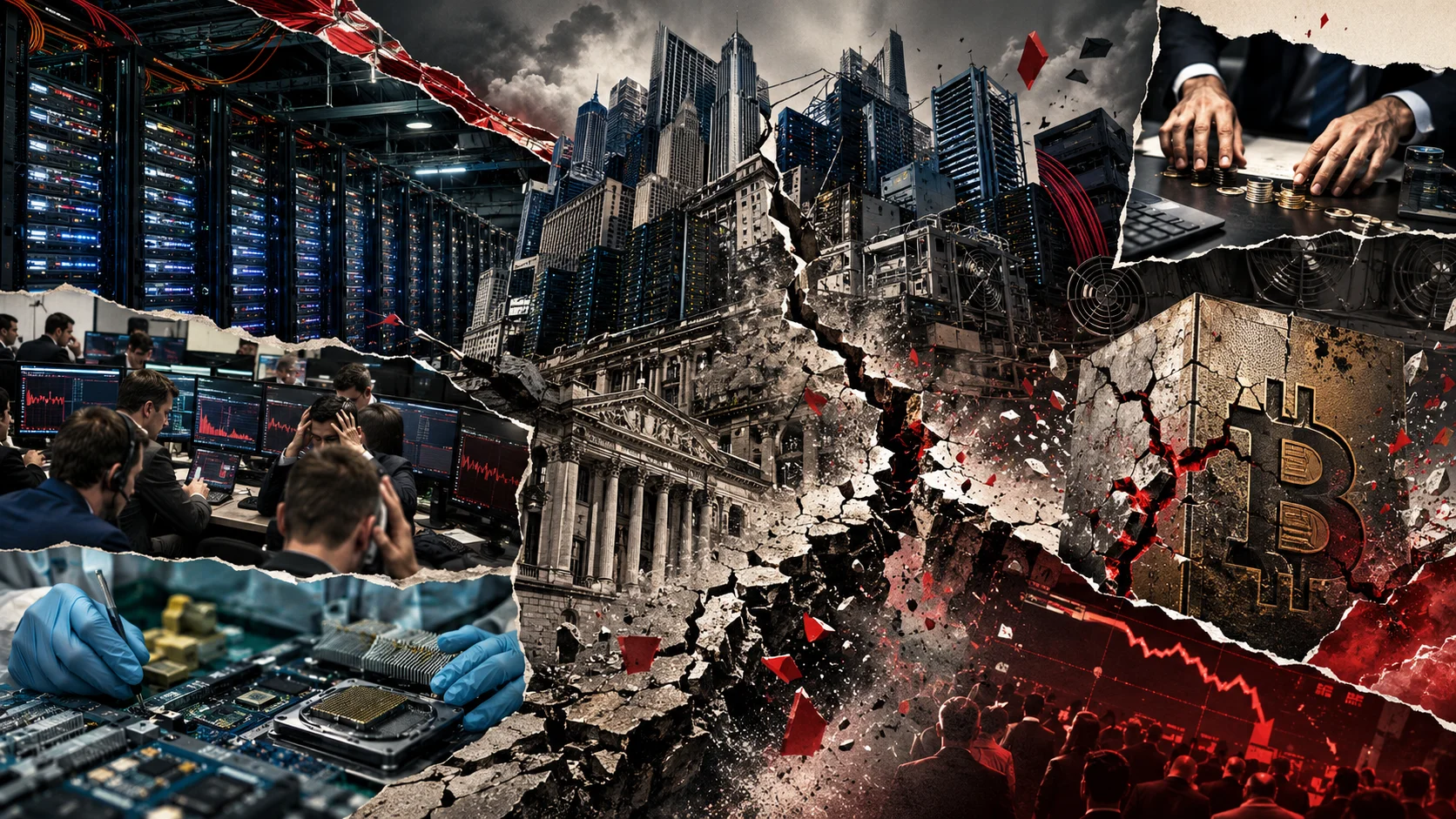
QCP Group published an analysis on Friday (14) pointing to the bursting of Wall Street’s artificial intelligence bubble, valued at US$ 800 billion, as the biggest threat to the next cycle of the cryptocurrency market. The note highlights that the tie between institutional capital invested in AI and the crypto sector has made the two markets vulnerable to a joint collapse.
Relationship between AI and cryptocurrencies
Alphabet CEO Sundar Pichai said no company will be immune if the AI bubble bursts. In its 2026 Global Financial Stability Report, the International Monetary Fund (IMF) addresses what it calls an interconnected ‘triple bubble’ of artificial intelligence, cryptocurrencies and sovereign debt.
In its Digital Assets Outlook for the 3rd quarter of 2026, QCP Group highlighted that Bitcoin remains a high-beta, institutionally adopted asset, but one dependent on real yields, ETF flows and risk appetite. In the 1st quarter of 2026, U.S. institutional capital migrated from cryptocurrencies to AI stocks, concentrating on semiconductors and computing infrastructure, while Bitcoin failed to sustain a lasting trend.
Spending on AI infrastructure by the four big tech companies rose from US$ 725 billion to nearly US$ 800 billion. The reopening of initial public offerings favored AI-linked stocks, such as SpaceX, which went public in June with a market value of about US$ 1.77 trillion and raised approximately US$ 75 billion.
Risks for stablecoins and deleveraging
The analysis also highlights the role of stablecoins, whose total supply reached about US$ 315–320 billion in the 1st quarter of 2026. Because these assets are backed by traditional reserves, such as U.S. Treasury securities, a bursting of the AI bubble could trigger panic and a liquidity crisis, spreading contagion to the traditional financial system.
BitMEX co-founder Arthur Hayes compared the current AI boom to the 19th-century railroad bubbles and warned of a mismatch in GPU financing: five-year loans for hardware that becomes obsolete in two. In his assessment, if cheaper Chinese models surpass Western rivals, the credit event could be ‘bigger than subprime’.
In a bursting scenario, the publication predicts a deleveraging cascade, with margin calls against hedge funds and non-bank financial intermediaries, generating a cycle of selling in both tech stocks and cryptocurrencies. Bitcoin and other liquid layer 1 assets would act as the system’s ‘ATMs’, being sold to cover losses. Speculative AI tokens and memecoins, which depend on Wall Street’s abundant liquidity, would disappear.
After the deleveraging, however, the analysis points out that a new decoupling cycle could begin, with Bitcoin benefiting from the scarcity narrative and from protection against the debasement of sovereign debt, which already exceeds US$ 100 trillion. ‘Capital will ultimately move out of overvalued AI stocks and banks into gold and Bitcoin,’ Hayes said. QCP Group summarized: ‘When cash pays an attractive real return, the market needs a better reason to hold a non-yielding hedge.’
The conclusion is that the AI bubble does not represent the end of cryptocurrencies, but a test that will force digital assets to compete on their own structural merits, rather than relying on Wall Street’s technological enthusiasm.