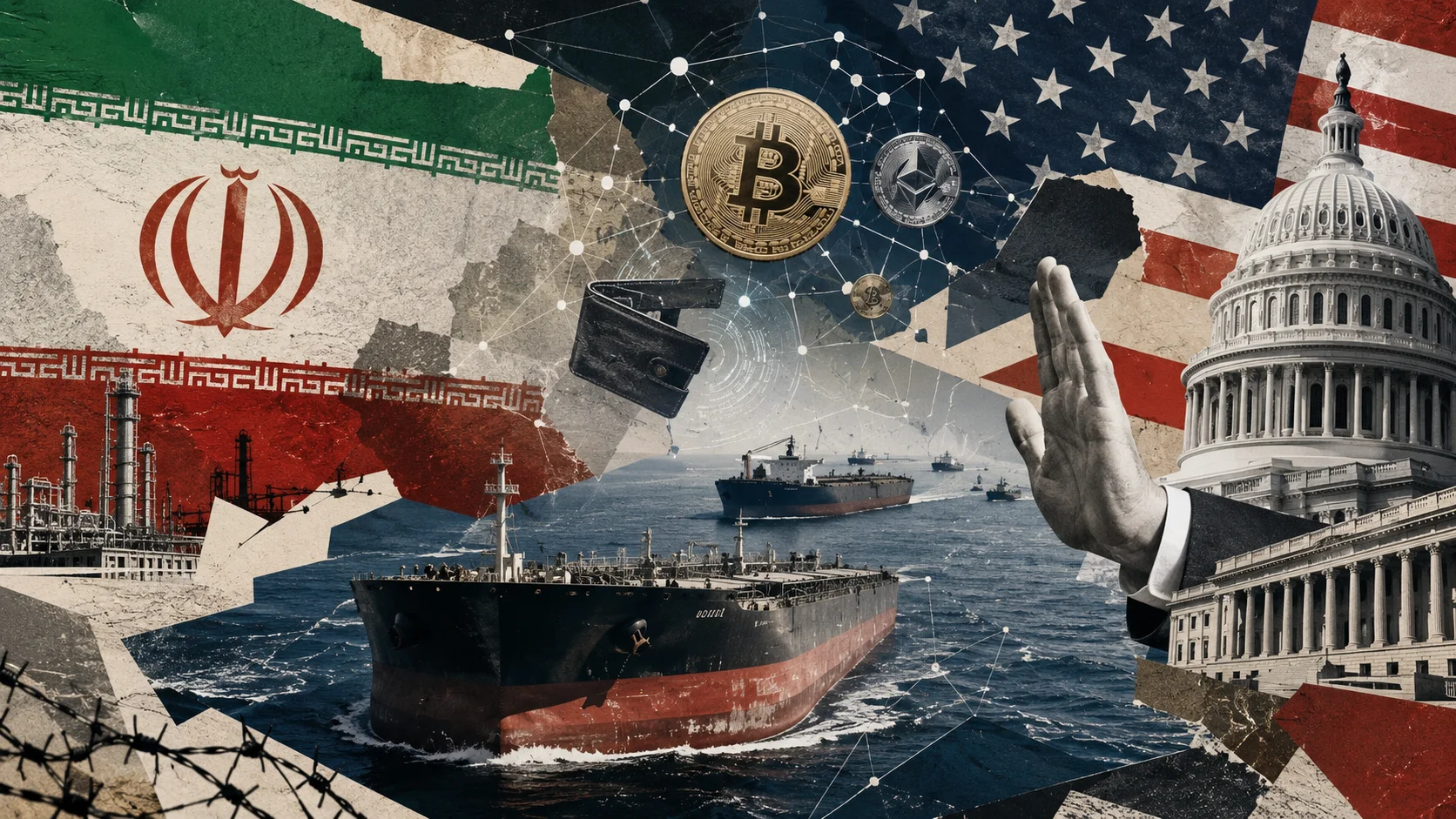
The United States expanded the scope of sanctions against Iran by including the country's digital asset sector among the areas of the economy subject to sanctions, a change that raises the risk for foreign companies that operate or provide services linked to the Iranian crypto market. The measure was announced by the Department of the Treasury on Monday (24), within a package that also hit a network accused of moving more than US$ 100 million in cryptocurrencies to facilitate Iranian oil sales.
The decision is part of Operation Economic Outcast, a campaign launched by the U.S. government against revenue sources and financial networks associated with the Iranian government and the Islamic Revolutionary Guard Corps (IRGC). The Office of Foreign Assets Control (OFAC) sanctioned nearly 60 people, companies and vessels linked to activities ranging from oil and military technology to cyber operations.
Crypto becomes a sanctionable sector of the Iranian economy
The main change for the cryptocurrency market lies in a new determination issued under Executive Order 13902. Until now, Washington had been focusing actions on exchanges, wallets and specific individuals. With the new rule, the very digital asset sector of Iran becomes part of the economic areas that can give rise to sanctions.
In practice, OFAC says it can sanction individuals or companies, regardless of the country in which they are located, if it determines that they operate in the Iranian sector or provide services in support of it. This expands the exposure of exchanges, financial intermediaries and other foreign businesses that maintain relationships considered relevant to Iran's crypto ecosystem.
The determination is not limited to digital assets. Technology, gold, aviation and maritime transport were also added to the areas covered by the measure. They join the financial, oil and petrochemical sectors, which were already subject to similar mechanisms.
The Treasury says cryptocurrencies have come to be used with increasing frequency by the Iranian government to circumvent financial restrictions and carry out transactions related to the IRGC and regime members.
The offensive on the crypto market had been expanding in recent months. In June, OFAC sanctioned Nobitex, Iran's largest digital asset exchange, as well as Wallex, Bitpin and Ramzinex. Data released by the Treasury itself showed that Nobitex had processed more than 50% of all Iranian digital asset inflows in 2025.
In August, the U.S. government returned to the sector by sanctioning other structures, including the exchange Aban Tether. OFAC had already warned that institutions and companies outside the United States could face sanctions when carrying out certain transactions with blocked Iranian platforms.
Broker allegedly moved US$ 100 million in crypto for oil sales
The new package also directly connects cryptocurrencies to one of Iran's main sources of revenue: oil exports.
The Treasury sanctioned Ukrainian citizen Ivan Obukhov, a resident of the United Arab Emirates, accused of acting for years as an intermediary for vessels of the so-called Iranian “ghost fleet” — ships used in structures designed to transport oil and circumvent international sanctions.
According to the U.S. government, Obukhov facilitated oil shipments for the benefit of the Iranian Armed Forces and their allies. Since 2023, he allegedly processed more than US$ 100 million in cryptocurrency payments to enable oil sales on behalf of the IRGC's Quds Force.
The Treasury also says that Obukhov took part in the purchase of vessels later used for sanctions evasion. He is owner and general manager of Foscom FZE, a company based in the United Arab Emirates and also included in the sanctions.
The maritime network hit by the package extends across different jurisdictions. The U.S. government cites intermediaries and companies in United Arab Emirates, Hong Kong, China, Singapore, Switzerland and Europe involved in oil transport or in moving revenues to structures linked to the IRGC.
Five ships were also identified as blocked property. Among them are the tankers Quantum Hope and Voyage Elite, which, according to the Treasury, carried millions of barrels of Iranian oil to China in 2026.
Sanctions also hit hackers linked to the Iranian government
The U.S. package also covers a network of hackers that Washington links to Iran's Ministry of Intelligence and Security.
The Treasury says members of the group compromised American companies in sectors such as energy, defense, health, technology and financial services, as well as local, state and federal government agencies. Some members also reportedly carried out attacks with the aim of personal enrichment.
One of those sanctioned, Arman Kahzadian, is accused of focusing on theft of digital assets. The U.S. government says he illegally took control, in 2023, of a wallet containing more than US$ 30,000 in bitcoin.
The action was coordinated with the FBI and took place six days after U.S. prosecutors announced an indictment against 17 members of the Mabna Institute, an Iranian group identified as responsible for an extensive hacking campaign against universities, companies and government agencies.
Foreign companies come within the reach of the offensive
The expansion of sanctions increases the importance of American rules also for businesses not based in the United States.
The Treasury says violations can lead to civil or criminal penalties and that foreign financial institutions involved in certain transactions with sanctioned people may face secondary sanctions, including restrictions on access to the U.S. financial system.
Assets and interests belonging to the designated individuals and companies that are in the United States or under the control of Americans are also blocked. The rule generally extends to companies controlled 50% or more by sanctioned people.
By turning digital assets into a sector formally covered by Executive Order 13902, Washington expands the offensive beyond already identified exchanges or wallets. The focus also comes to include foreign companies and intermediaries that continue to provide relevant support to the Iranian crypto infrastructure.