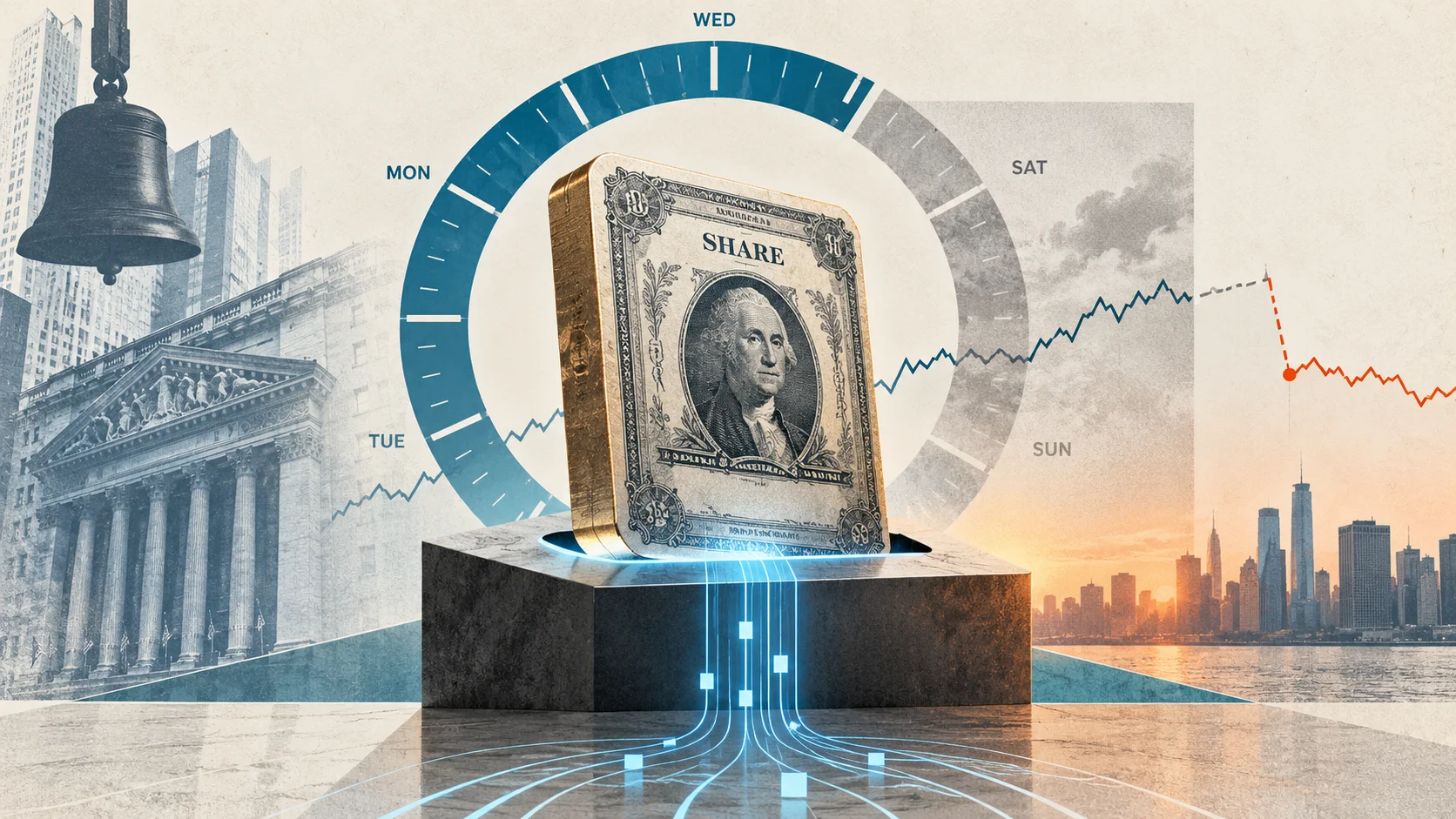
Aave has begun accepting tokenized stocks from Coinbase as collateral for USDC loans on Base, bringing Apple, Nvidia, Microsoft, and other American giants into a credit market that doesn't close. The integration expands the utility of these assets beyond on-chain trading, but it also creates a structural problem: the borrowing works 24 hours a day, while the collateral's main price reference still has periods without continuous trading.
The question, therefore, is not only whether stocks can become collateral in DeFi. It is how to liquidate a position at any time when the asset backing that debt can go dozens of hours without a new, sufficiently deep price reference.
Credit is 24/7, but the oracle is not
The new Aave V4 Equities Hub, on Base, initially accepts AAPLc, AMZNc, GOOGLc, METAc, MSFTc, NVDAc, and TSLAc as collateral. The tokens represent economic exposure to stocks held in segregated custody by Alpaca Securities and are intended for eligible users outside the United States. At launch, they serve only as collateral; the only asset that can be borrowed is USDC.
On-chain infrastructure remains continuously available. The problem appears at the pricing layer.
Aave uses Chainlink feeds that cover regular trading hours, pre-market, after-hours, and an overnight session. This creates a price window of 120 out of the 168 hours in a week, from Sunday at 8 p.m. to Friday at 8 p.m., U.S. Eastern Time. Between Friday night and Sunday night, in addition to market holidays, the feed keeps the last published value.
This produces an unusual situation: the tokens can continue circulating and trading in on-chain markets 24/7, but the value used by Aave to calculate collateral remains frozen while the oracle is closed. Base itself presents continuous trading as a central feature of tokenized assets.
If news brings down expectations for a company on Saturday, for example, the token's price on an AMM may react. The position's health factor on Aave, however, will not be immediately recalculated by this market move.
During that interval, it can deteriorate only from the accrual of debt interest. The price shock enters the calculation when the feed resumes publishing.
Risk does not disappear: it is converted into a haircut
Aave's initial solution does not try to eliminate this mismatch. It incorporates it into the risk parameters.
In V4, the collateral factor functions simultaneously as the borrowing limit and the liquidation threshold. For the seven stocks, it ranges from 65% for Meta and Tesla to 79% for Microsoft. Apple starts at 78%, Alphabet at 76%, Amazon at 73%, and Nvidia at 70%.
In practice, a stock valued at US$ 100 does not support US$ 100 of debt. Part of the value is deliberately left out to absorb volatility, interest, liquidation costs, and, especially, moves that can occur while the relevant markets are closed.
The calculation used by LlamaRisk considered intraday data since 2018, including pre-market, regular trading hours, after-hours, and, more recently, overnight trading. Weekends and holidays were treated as part of the interval in which a position can remain exposed before a liquidation can actually be closed out.
The modeling even considered a closure of 92 hours and 35 minutes, corresponding to the combination of a shortened session with a long weekend.
This is the mechanism by which a 24/7 market can accept collateral that does not have equally continuous price discovery: not by making Wall Street 24/7, but by reducing in advance how much credit each dollar of stock can support.
The most delicate moment is the reopening
The frozen price also concentrates risk at a specific point.
If negative information emerges while the feed is stopped, a position may appear healthy during the weekend. When Chainlink resumes publishing on Sunday night, the new price starts to reflect the information accumulated during the period.
A sufficiently large drop can make the health factor immediately cross the liquidation threshold. According to Aave's risk documentation, a position affected by news after Friday's close can become liquidatable at the feed's reopening on Sunday, while the first truly deep market for hedging the underlying stock may only be available on Monday.
Tokenization, therefore, does not eliminate gap risk. It changes where that risk needs to be managed.
And there is a second difficulty: the secondary market for the tokens themselves is still small. The analysis used by Aave found between approximately US$ 300,000 and US$ 1.1 million in depth per asset for a sale with an impact of up to 2%.
Moreover, not every liquidator can simply return the token to Coinbase and receive the corresponding stock. Direct redemption depends on an issuer eligibility process; anyone who receives tokens in a liquidation without that condition must sell them on the secondary market, complete the necessary redemption process, or maintain a hedge until they can close out the exposure.
This turns liquidation into a problem of price, liquidity, and access simultaneously.
DeFi begins to depend on a hybrid infrastructure
The most interesting consequence appears in how Aave sized the market.
The initial limits were not defined only by the historical volatility of the seven stocks. The analysis also considered the depth of the tokens on DEXs, the capacity for minting and redemption, and even the open interest of stock perpetuals traded on platforms such as Hyperliquid, Binance, OKX, and Lighter, which can serve as a hedge when the traditional market is closed.
The result is a deliberately small market at the start. The caps for the seven stocks total about US$ 29.3 million in collateral, while the debt limit in USDC was set at US$ 21 million. The risk assessment itself concluded that, at launch, liquidity is the dominant constraint, not the protocol's mathematical capacity to extend more credit.
This reveals a larger consequence of stocks entering DeFi.
The resulting infrastructure is not purely TradFi nor purely crypto. The real stock remains in regulated custody; the token circulates on Base; Chainlink connects different trading sessions to the protocol; Aave manages the debt; DEXs provide part of the liquidity; and crypto derivatives markets can help protect a liquidation until the traditional market offers depth again.
Turning stocks into programmable collateral, therefore, does not remove the restrictions of the traditional market. It forces DeFi protocols to incorporate them directly into their risk design.
The next relevant change is already identified. Aave's documentation plans to review the parameters if Chainlink 24/7 feeds for these assets go into production. This could allow liquidations throughout the weekend and reduce part of the current mismatch, although market depth, redemption, and liquidity remain independent constraints.
The test for this model will not be just how many stocks will be tokenized. It will be how much credit can be built on them without DeFi's speed outpacing the liquidity and infrastructure that still remain outside the blockchain.