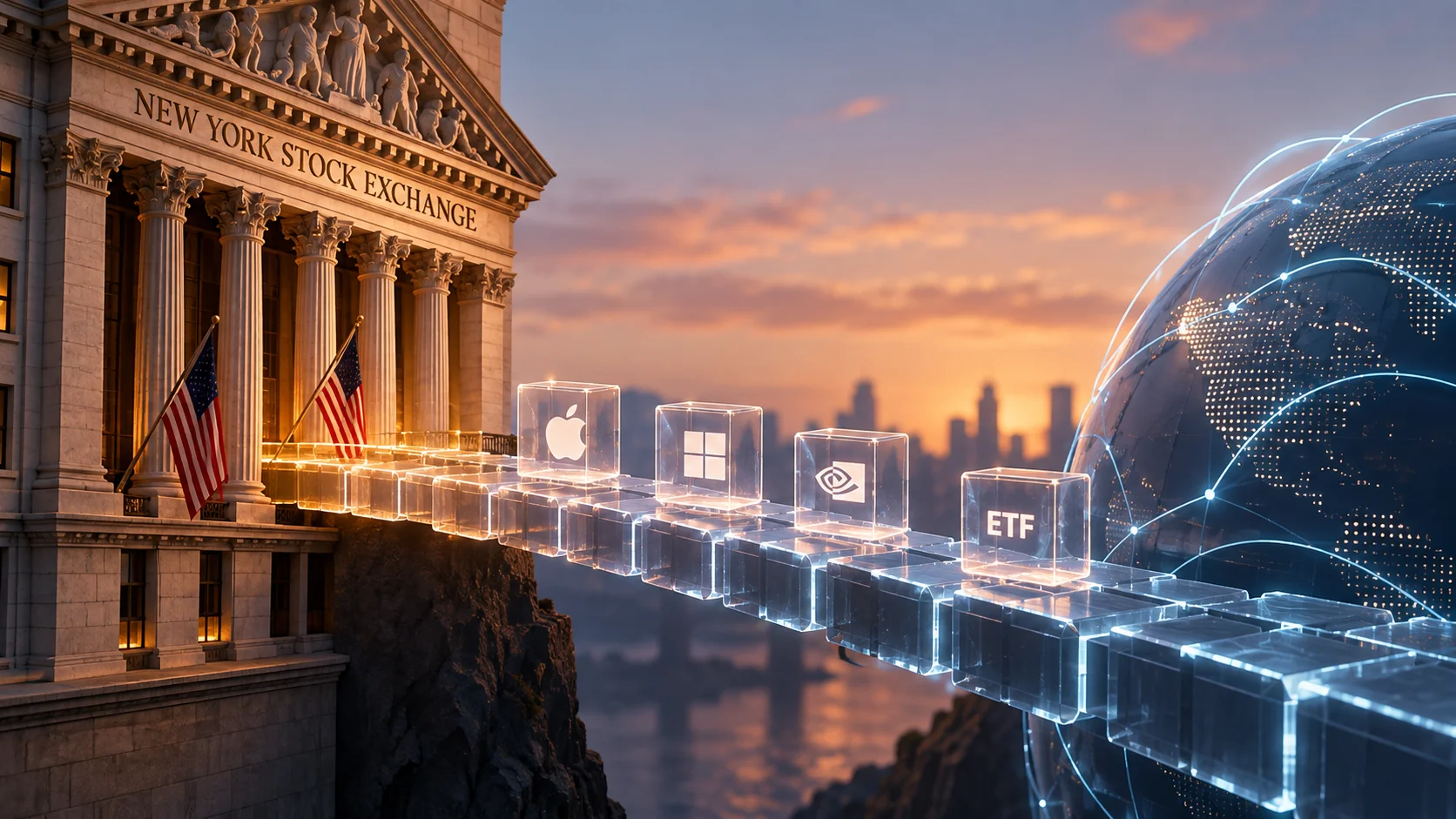
The New York Stock Exchange and Blockchain.com have reached an agreement to explore access, 24 hours a day, seven days a week, to tokenized U.S. stocks and ETFs through the digital platform planned by NYSE. The service is not yet operational and depends on regulatory approvals, but the significance of the move goes beyond another crypto platform offering tokens tied to stocks: one of the world's largest exchanges is building a direct bridge between its own market infrastructure and crypto-native investors.
This changes the main question around tokenized stocks. The discussion is no longer just whether crypto companies can create blockchain representations of traditional stocks; it now involves something bigger: can trading, settlement, ownership records and funding migrate to onchain infrastructure without eliminating the rights and protections associated with traditional securities?
NYSE is building something different from the first generation of stock tokens
Blockchain.com and NYSE have not yet disclosed a launch date, which assets would be available initially or the countries served. Blockchain.com says the integration could bring NYSE's platform to tens of millions of users and also plans to integrate ICE and NYSE market data into its app.
The most important point, however, lies below the distribution layer.
When it introduced its digital platform in January, NYSE described a structure capable of offering continuous trading, fractional orders, stablecoin funding and near-instant onchain settlement. The architecture combines the Pillar matching technology, used by the exchange, with blockchain-based post-trade systems and was designed to support different networks for settlement and custody.
NYSE also said the platform will be able to trade tokenized stocks fungible with traditionally issued shares, preserving economic and corporate rights, such as dividends and voting participation.
This characteristic sets it apart from some of the stock tokens that have already circulated in the crypto market.
Reuters highlighted that some of these products offer economic exposure to a stock's price without necessarily turning the buyer into a shareholder in the company or granting the same rights as the traditional asset.
The difference is material. A token that only tracks the price of Apple or Tesla is not equivalent to a blockchain representation of a real stock with attached corporate rights.
SEC opened a regulatory route, but preserved shareholder rights
A few days before the announcement involving NYSE and Blockchain.com, the Securities and Exchange Commission created a temporary five-year exemption, called the Innovation Exemption, to allow certain platforms to trade tokenized U.S. stocks through onchain structures.
The measure establishes an important separation.
Synthetic tokens that only reproduce economic exposure to a stock do not automatically fall under the model. Eligible assets need to grant the investor rights equivalent to those of the corresponding traditional security, including dividends and voting rights.
Issuing companies may also object when third parties want to tokenize their shares without the issuer's direct participation.
Other limitations show that the model is still far from a fully permissionless structure. Smart contracts need to be auditable, there are operational restrictions and trading of a tokenized stock must be halted if the original asset suffers a trading halt on its primary exchange.
The U.S. regulatory experiment, therefore, does not simply eliminate Wall Street's traditional structure to replace it with crypto rules. The goal is to put blockchain rails under securities while maintaining essential parts of the existing regulatory architecture.
It is exactly at this point that NYSE's proposal gains relevance.
Tokenization begins to put two market architectures face to face
NYSE is not alone.
In March, the SEC approved a Nasdaq proposal allowing certain securities to be traded in traditional or tokenized format. Initially, the structure includes Russell 1000 stocks and ETFs tied to major indexes.
In this model, however, settlement remains tied to the Depository Trust Company.
The architecture proposed by NYSE advances more directly into blockchain infrastructure. The project includes onchain settlement, stablecoin funding and potential integration with blockchain-based custody systems.
The difference turns tokenization into a much broader test:
which parts of the current capital markets infrastructure really need to keep operating the way they operate today?
U.S. stocks already operate under T+1 settlement. An onchain infrastructure could reduce that interval even further, but putting a stock on a blockchain does not by itself solve the rest of the operation.
Money, custody, transfer agent records, corporate events, compliance systems and liquidity also need to keep pace with the new settlement layer.
NYSE has already begun assembling some of these pieces.
In March, it reached an agreement with Securitize to work on digital transfer agent infrastructure, responsible for ownership records and corporate events. In parallel, ICE has been working with BNY and Citi on tokenized deposits that could allow clearing members to move funds outside traditional banking hours.
This point is decisive.
A 24/7 stock market is only truly 24/7 when the infrastructure around trading can also operate continuously.
Duke University finance professor Campbell Harvey summarized one of the reasons stocks appear as one of the first candidates for this transformation:
“Tokenized stocks are probably the lowest hanging fruit.”
The logic is simple. Stocks already have established prices, known issuers, defined ownership rules and liquid markets. Tokenization does not need to create the asset. It needs to demonstrate that another technological infrastructure can trade and settle it efficiently.
Blockchain.com can turn crypto platforms into distribution channels
Blockchain.com adds another important layer to NYSE's design: distribution.
The company already offers tokenized U.S. stocks outside the United States through Ondo Finance. The service was expanded this year to countries in the European Economic Area after already offering hundreds of tokenized stocks and ETFs in markets in Africa and South America.
A direct connection with NYSE would create a different relationship.
Instead of a crypto company independently creating or distributing its own representation of a stock, a crypto-native interface could work as a gateway to assets traded on infrastructure built by the traditional exchange itself.
If this model gains scale, crypto platforms could compete not only as alternative trading venues but as global distribution layers for established exchanges.
This possibility, however, still depends on several conditions.
The companies did not specify the jurisdictions served, the eligible investors or the initial asset universe. NYSE's own digital platform still depends on the necessary approvals to begin operating.
A 24/7 market can also fragment liquidity
Moving stocks to different blockchain environments creates an additional problem: the same asset could start being traded simultaneously on traditional exchanges and on various tokenized platforms.
The Securities Industry and Financial Markets Association warned that parallel versions of U.S. securities can generate price and liquidity fragmentation, in addition to confusion for investors.
Fungibility between the versions could reduce part of that risk.
If an NYSE tokenized stock can be efficiently converted into its traditional version, arbitrageurs could act to keep prices aligned between markets.
But the efficiency of this mechanism will depend on conversion speed, custody infrastructure, redemption rules, operating hours and, above all, the depth of liquidity in each market.
The SEC's requirement that tokenized platforms respect the trading halts of the primary exchange precisely shows this dependency.
A blockchain can operate without interruption, but the asset represented on it remains connected to an issuer, to legal rights and to a regulated infrastructure that maintains its own control mechanisms.
The real test will be tracking where liquidity goes
The agreement between NYSE and Blockchain.com does not yet mean that Wall Street has migrated to blockchain.
The announcement is a memorandum related to a platform that is still awaiting approvals, has no public launch date and has not revealed which stocks or ETFs will be traded first.
But the moves are beginning to form a broader architecture.
NYSE has designed an onchain trading and settlement platform. Securitize entered the discussion on transfer agent infrastructure. ICE is working on tokenized funding mechanisms. The SEC opened a temporary route for tokenized U.S. stocks. And now Blockchain.com can offer a distribution layer aimed directly at the crypto public.
The decisive question is no longer whether a stock can be turned into a token. It is whether liquidity, settlement and ownership can migrate along with it.
The next signals are objective: regulatory approval of NYSE's platform, definition of the first traded assets, conversion mechanisms between traditional and tokenized stocks, jurisdictions served by Blockchain.com, liquidity available outside conventional hours and direct participation by issuing companies.
If these pieces start working together, tokenized stocks will cease to be just a parallel product within the crypto market.
They will begin competing for space within the very infrastructure used to trade and settle public stocks.