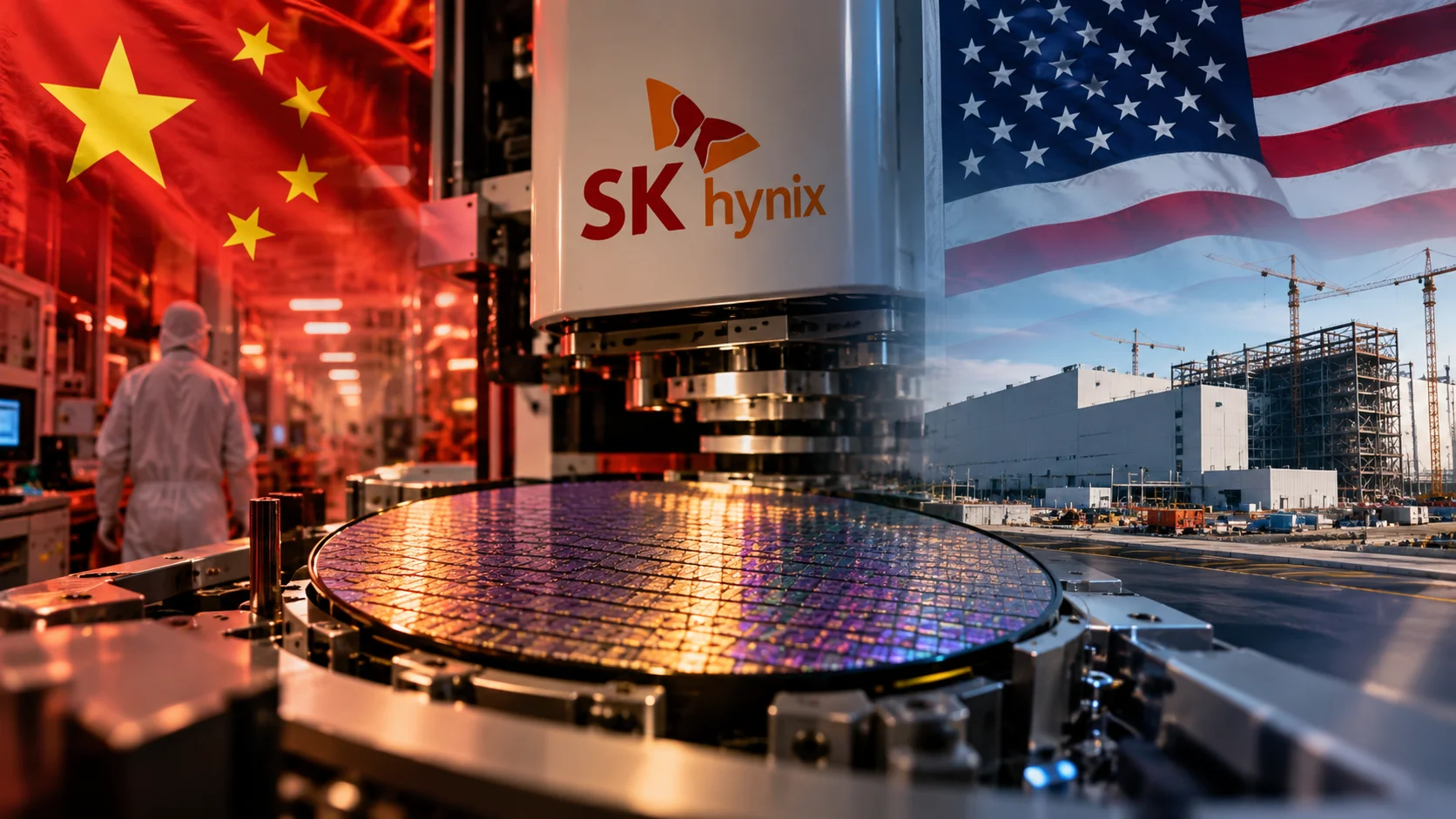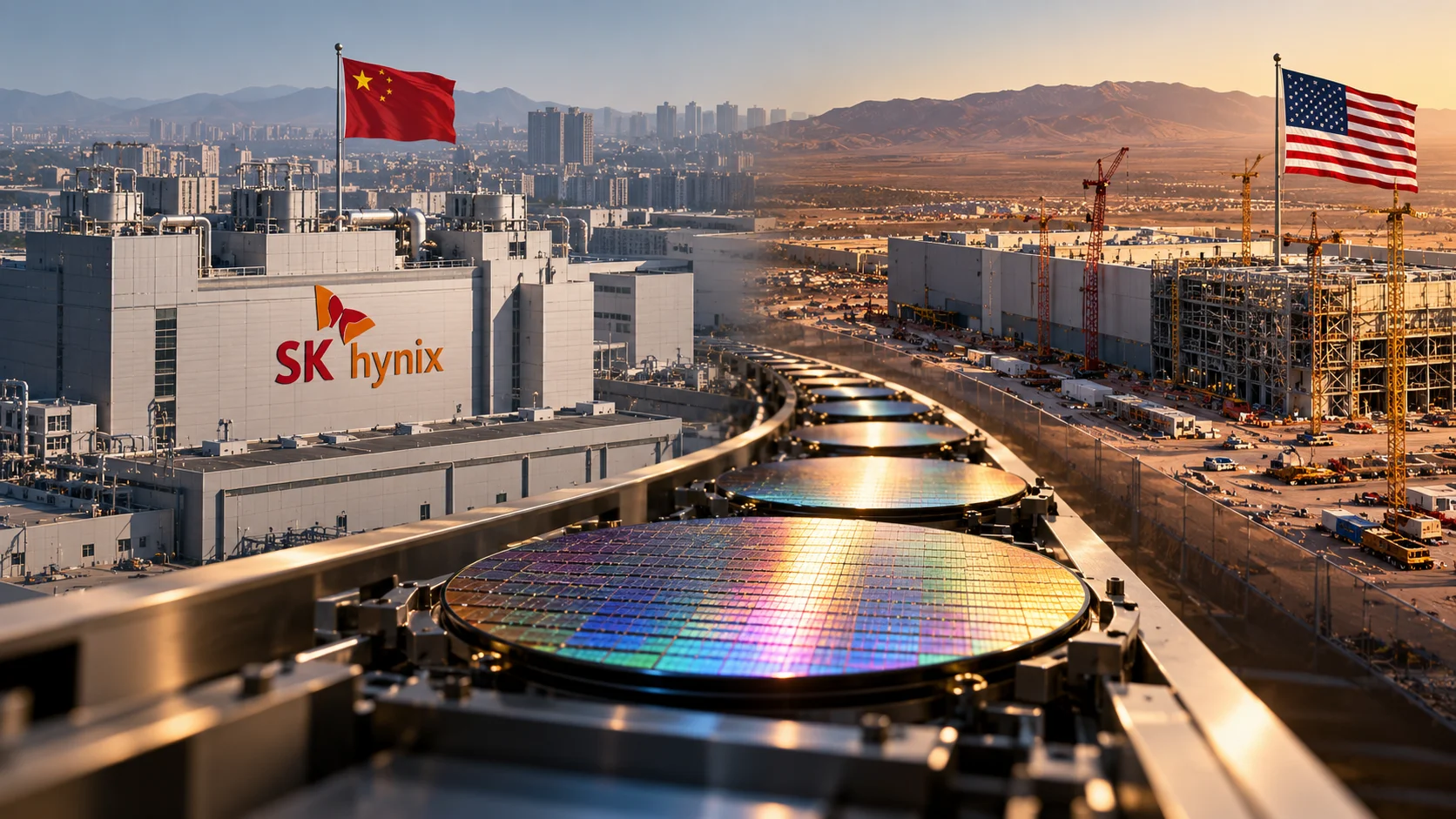
TSMC has accumulated US$ 265 billion in investment commitments in Arizona, while SK Hynix negotiates American authorizations to install equipment in a factory in China that, according to sources who spoke to Reuters, could help finance a future unit in the United States. The two moves coincide with a warning from ASML about possible limitations in the supply of machines for manufacturing semiconductors. Together, they expose an issue that is not readily apparent in the expansion of American industry: building factories on national territory does not necessarily mean controlling the production chain that keeps them running.
The growth of artificial intelligence is accelerating investments in industrial capacity, but also increasing the importance of resources concentrated in a few companies and regions. The manufacturing of advanced processors, memory and specialized equipment depends on different technologies and industrial structures, which cannot be transferred from one country to another at the same speed.
The consequence is a reorganization of existing dependencies, rather than their elimination.
Billion-dollar investments do not represent immediately available capacity
TSMC's results show why manufacturers are accelerating their projects. In the third quarter of 2026, the company recorded net income of NT$ 763.1 billion, growth of 68.7% compared with the previous year, and revenue of US$ 46.72 billion.
Manufacturing processes of 7 nanometers or more advanced accounted for 79% of revenue from wafers. The 2-nanometer technology alone represented 8%, showing the rapid commercial expansion of the most sophisticated processes.
These numbers demonstrate the scale of the company's global operations, but they do not indicate how much of this production takes place in the United States, nor do they allow all revenue to be attributed to artificial intelligence.
The American expansion is already showing concrete results. TSMC's first factory in Arizona began volume production with 4-nanometer technology at the end of 2024. The second unit, intended for 3-nanometer processes, had its construction completed and is expected to begin volume production in the third quarter of 2027.
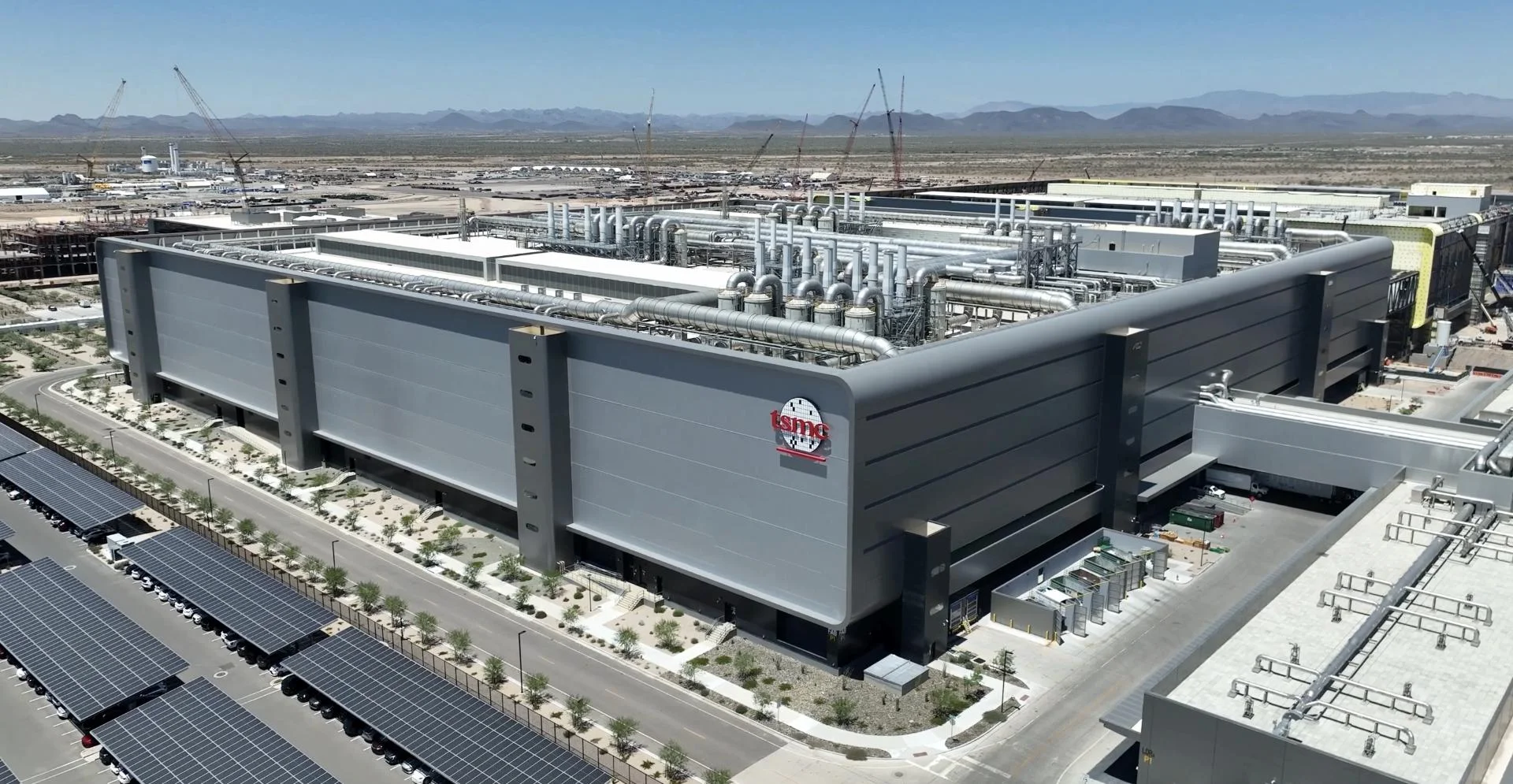
The total financial commitment reached US$ 265 billion after the company announced another US$ 100 billion in July 2026, expanding its plans for logic manufacturing and advanced packaging facilities.
The announced amount, however, does not equal expenses already incurred or installed production capacity. A relevant part of the investment depends on construction, equipment installation, hiring professionals and qualification of industrial processes.
There is also a difference between transferring already developed technology and establishing a complete ecosystem to operate it. The first requires infrastructure and industrial execution. The second involves local suppliers, specialized maintenance, materials, research and integration with other stages of production.
The United States is advancing in the first task, but completing the second will require more time.
The SK Hynix case reveals a different industrial dependency
The negotiation involving SK Hynix presents an apparent contradiction: the possibility of a new American factory depending, initially, on investments in a facility located in China.
According to a Reuters report published on October 15, the company is seeking authorization to acquire additional American equipment intended for the area known as Mod B, at its Dalian facility, operated in the context of Solidigm's activities.
Part of this structure was built in 2023, but did not receive all the equipment originally planned due to the previous downturn in the memory market.
Sources familiar with the negotiations told Reuters that increasing production in Dalian would help generate resources for a future NAND factory in the United States, in addition to sustaining supply during the implementation of the new unit.
The company confirmed that equipment installation in the Mod B area takes place through consultations and authorizations from the US government, but stated that it is not seeking to expand its production capacity in that space.
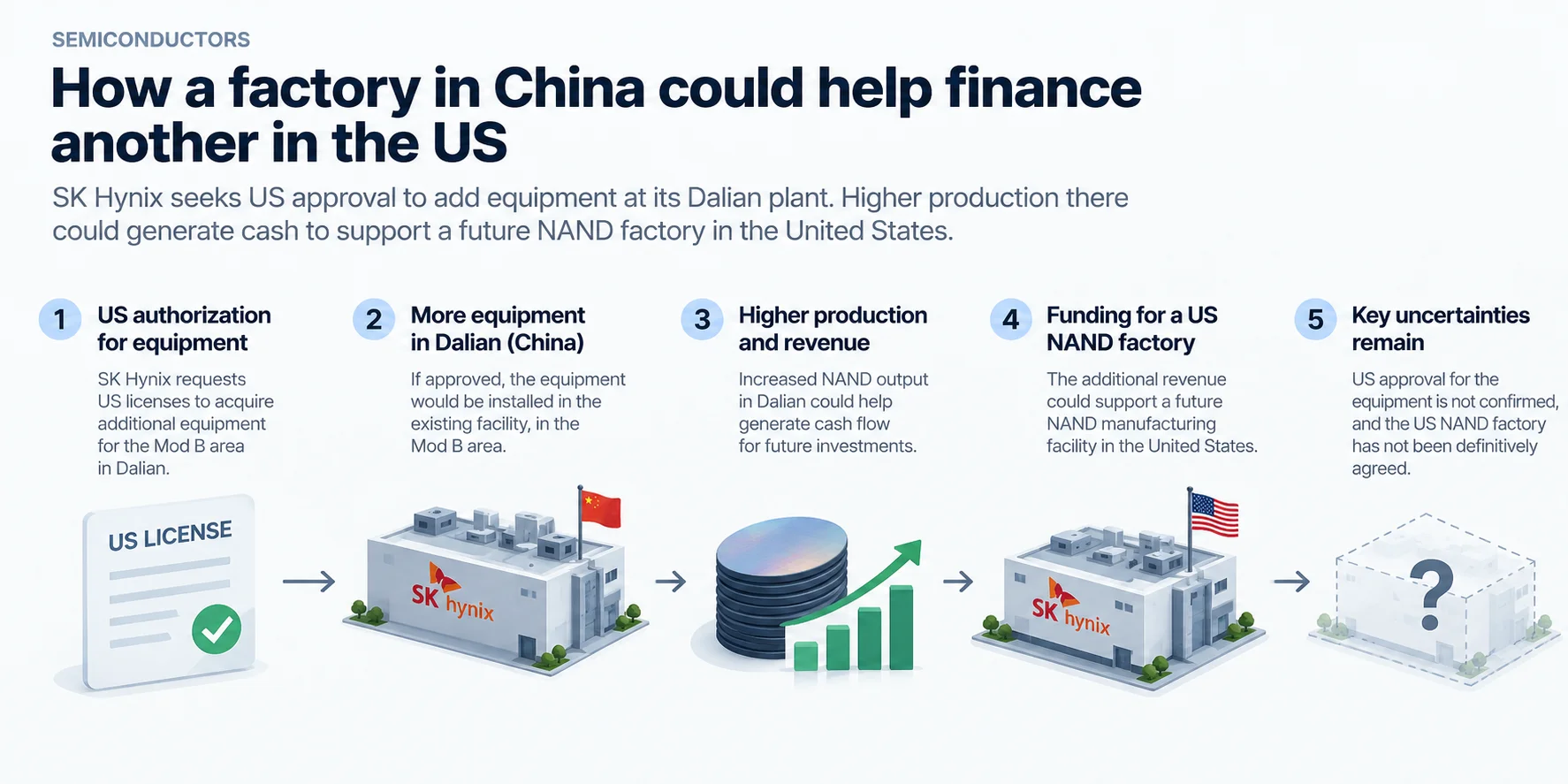
There is no confirmation that Washington has approved the additional licenses requested or that the construction of an American NAND factory has been definitively agreed. The link between the two projects remains based on information obtained by Reuters from its sources.
The episode also requires an important technological distinction.
The NAND memory manufactured in Dalian is used mainly for data storage, including server SSDs. It participates in the infrastructure required for artificial intelligence, but does not perform the calculations carried out by accelerators such as GPUs.
These processors use advanced logic chips, manufactured by companies such as TSMC, and frequently work with HBM, high-bandwidth memory built from DRAM.
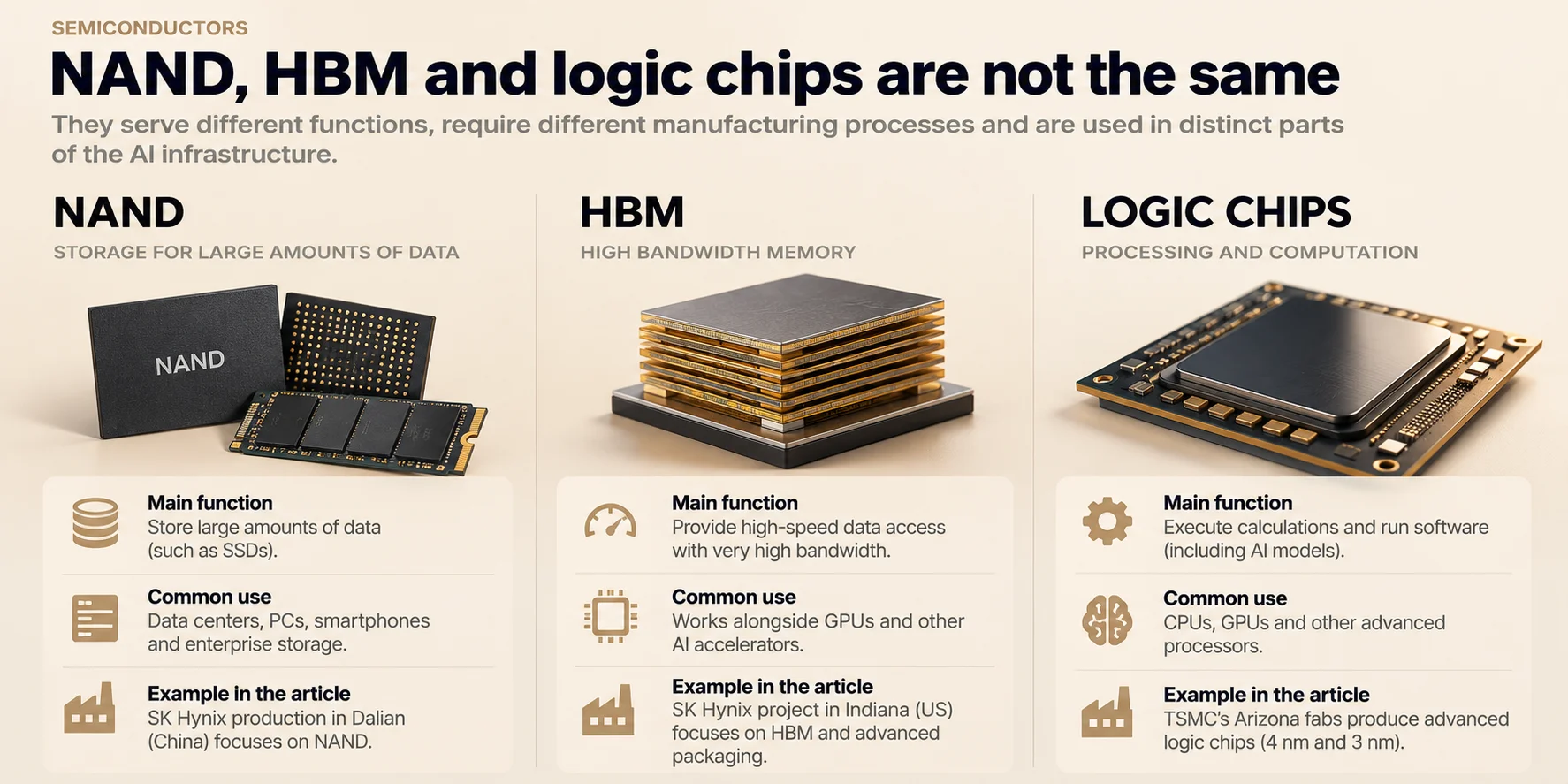
SK Hynix also has a project of approximately US$ 3.87 billion in Indiana, aimed at advanced packaging of HBM memory and related research. This facility should not be confused with the possible American NAND factory.
Thus, the investments in Dalian, Indiana and Arizona serve distinct industrial needs. Adding them together as if they all represented the same AI chip production capacity would produce a misleading comparison.
The bottleneck may be in the equipment, not in the location of the factories
The discussion about Dalian exposes another characteristic of the semiconductor chain: a factory's address does not by itself determine which technologies it can use.
The Chinese facility depends on equipment supplied by American manufacturers such as Lam Research, Applied Materials and KLA, involved in fundamental stages of processing, deposition, material etching and inspection.
In August 2025, the Bureau of Industry and Security, an agency of the United States Department of Commerce, withdrew authorizations that allowed certain foreign factories in China to receive American equipment without individual licenses.
The agency said it intended to continue authorizing existing operations, but not capacity expansion or technological upgrades at these units.
This distinction explains part of the difficulty faced by SK Hynix. Keeping a factory running and authorizing the installation of new equipment are different regulatory decisions, especially when there is physical capacity built that has not yet been fully equipped.
The availability of the machines represents a second restriction, independent of the regulatory decision.
On October 14, ASML reported quarterly sales of € 11.7 billion and net income of approximately € 5 billion. The Dutch manufacturer also stated that its currently planned supply may be insufficient to meet customer demand in 2027 and 2028.
According to CEO Christophe Fouquet, some customers are already expressing interest in orders for 2029 and even 2030. The company is considering expanding the capacity planned for 2028 beyond the 30% increase previously announced.
This does not mean that all these orders are confirmed or that future delays are inevitable. It is an assessment by the manufacturer in light of its customers' projections.
ASML supplies extreme ultraviolet lithography systems, known as EUV, essential for certain layers of the most advanced logic chips and sophisticated DRAM memory. It also produces DUV equipment, used in different industrial processes.
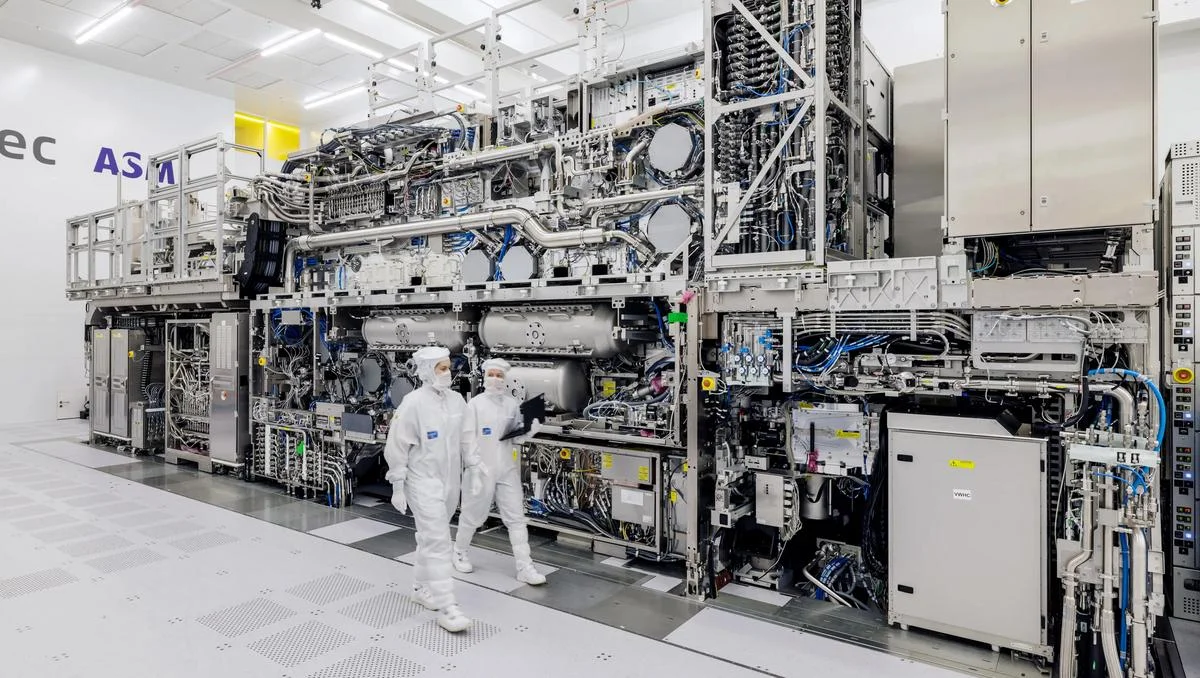
The needs of a NAND factory are not identical to those of an advanced logic facility. Nor are all the machines sold by ASML EUV systems.
Another data point from the results illustrates this complexity: approximately € 3.3 billion of quarterly sales came from services and upgrades to already installed equipment.
Increasing global semiconductor production does not depend only on building new factories. It also requires raising the productivity of existing facilities, keeping machines operational and ensuring access to the technologies needed to modernize them.
The American expansion redistributes risks, but also requires international integration
The comparison between TSMC, SK Hynix and ASML reveals three forms of industrial dependency.
The first lies in the concentration of knowledge and manufacturing capacity. TSMC can operate in the United States, but continues developing and producing advanced technologies in Taiwan, where it has an extensive industrial infrastructure.
The second appears in the specialization of components. Logic processors, NAND and HBM fulfill different functions, require specific facilities and need to be integrated to meet the needs of AI systems.
The third involves equipment and authorizations. A factory installed in China may depend on American machines and Washington's approval, while an American advanced logic unit continues to depend on lithography systems produced in Europe.
This structure does not mean that expansion in the United States is incapable of reducing risks. Distributing manufacturing capacity across regions can reduce exposure to disruptions concentrated in a single territory.
The construction of advanced packaging facilities may also reduce the need to send certain components for processing in other countries.
But these benefits depend on completed projects that are effectively integrated into commercial operations.
During the transition, a company may begin managing factories in more countries without ceasing to depend on the same essential suppliers. In certain processes, geographic distribution still adds needs for transportation, technical coordination and synchronization between units.
Therefore, there is not enough evidence to state that the investments are creating an entirely new industrial dependency. The observed movement is primarily the redistribution of an already interdependent chain, with new facilities being incorporated before all complementary capabilities are available locally.
The next decisions will allow measuring production autonomy
Three developments will help evaluate the concrete effects of this reorganization.
The first is the American decision on the additional equipment intended for the Dalian facility. A possible authorization could clarify the conditions imposed on SK Hynix, but will not automatically mean that the NAND factory in the United States will be built.
The second is the expected start of volume production at TSMC's second factory in Arizona, in the third quarter of 2027. The evolution of the capacity actually utilized and the implementation of the packaging facilities will allow assessing how much of the production process can be carried out in the country.
The third is ASML's industrial response to projected demand for 2027 and 2028. The actual availability of equipment and its installation in factories will be more concrete indicators than the early interest in orders for the end of the decade.
It will also be necessary to monitor investments actually executed, manufacturing yields and capacity delivered to the market. Without equivalent metrics, it is not possible to establish reliable comparisons of cost or productivity between American and Asian factories.
The events of October leave a bounded conclusion: the United States is expanding its capacity to manufacture semiconductors, but has not yet demonstrated autonomy over the entire chain necessary to produce the most advanced chips.
The difference between these two conditions will be determined less by the volume of announced investments and more by the ability to put factories, equipment, memory and complementary processes into joint operation.