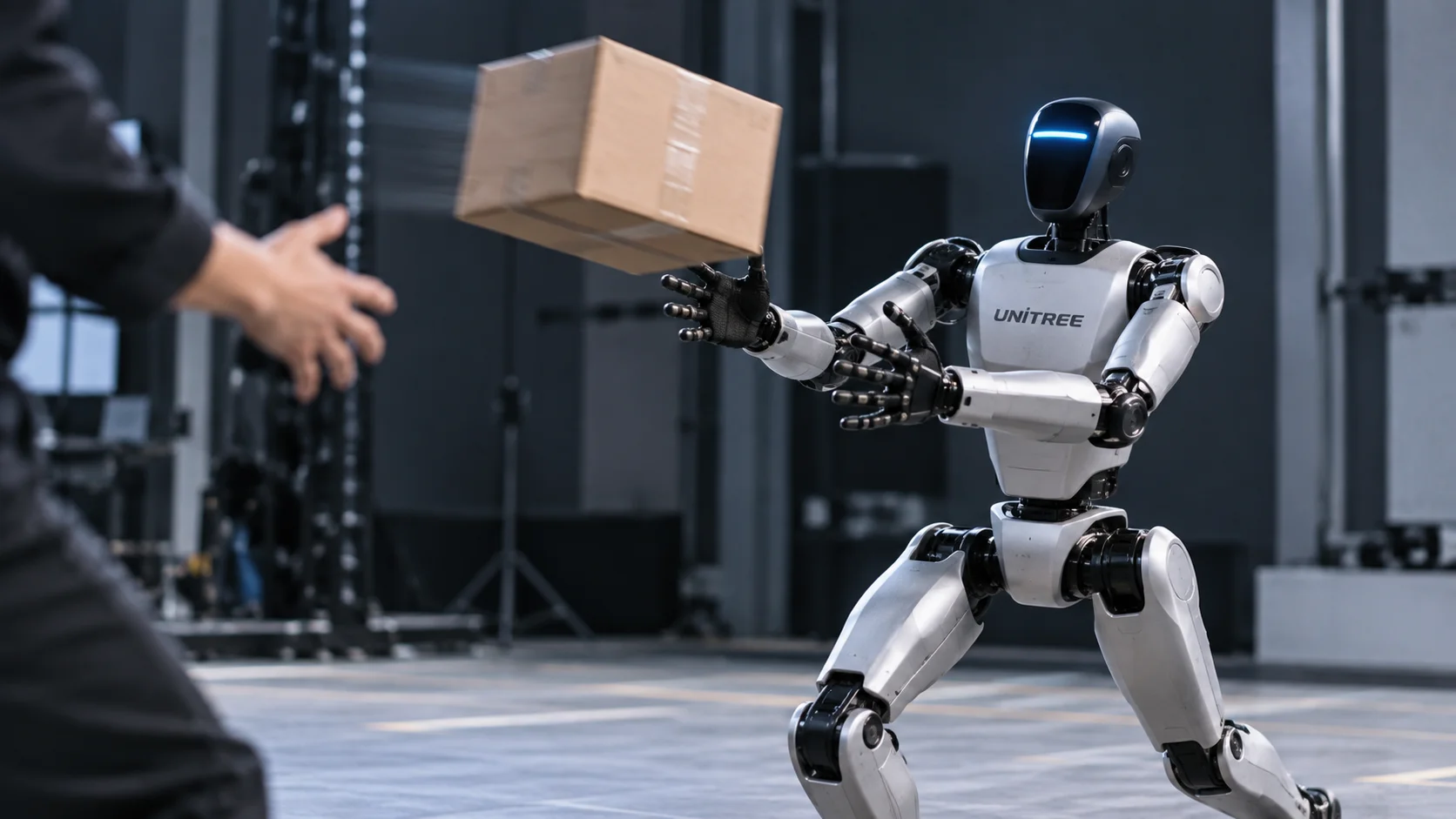
A box is thrown toward a humanoid robot. It has approximately one second to identify the object, predict its trajectory and move its arms, legs and torso before impact. In the experiments, the Unitree G1 managed to catch 13 of 20 boxes thrown at 2.5 meters, using only sensors installed on its own body.
The capability was demonstrated by Reflex, an artificial intelligence system developed by researchers from institutions such as University of Washington, Stanford University and University of Southern California. The work, made available on arXiv on October 8, 2026, investigates how humanoid robots can physically react to moving objects without relying on external cameras or tracking systems.
The challenge goes beyond reaching a box in midair. To complete the task, the robot needs to position its forearms, use its torso as support, absorb the impact and keep the object secure without losing balance. Touching the box is not enough: it must be caught and held.
Robot achieved 65% success rate, versus 85% for human participants
In the physical tests, the researchers compared the performance of the Unitree G1 with that of three human participants, subjected to similar throws.
At 2.5 meters, the robot recorded 65% success, versus 85% for humans. When the distance increased to 5 meters, the rates fell to 40% and 68.3%, respectively.
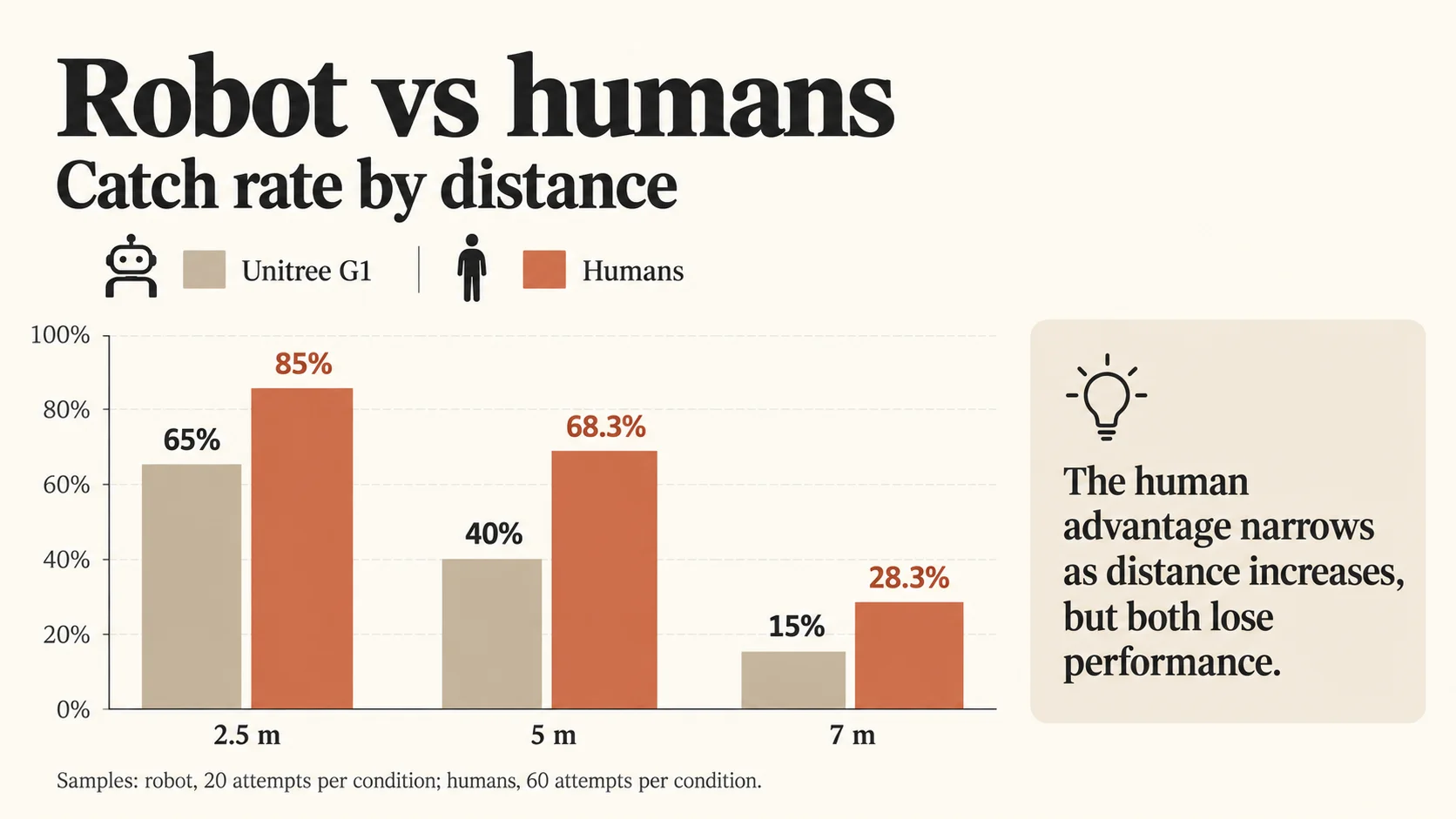
At 7 meters, the difficulty became evident for both: the G1 caught only 15% of the boxes, while human participants reached 28.3%.
Each condition involved 20 trials with the robot and 60 with the humans. The results show a physical capability effectively demonstrated, but still far from human consistency under the evaluated conditions.
Performance also varied according to the characteristics of the objects. In tests with boxes of different dimensions, the robot managed to catch 20% of the smaller ones and 45% of the larger ones, even physically reaching some that it could not hold.
This difference reveals an important difficulty: intercepting a moving object does not necessarily mean managing to retain it.
The secret lies in predicting movement, not just seeing the box
The main scientific contribution of Reflex lies in the way visual perception and body control work together.
The system was developed in three stages. First, the robot learned catching movements through reinforcement learning in simulation, receiving detailed information about the box's position. Then, it was trained to deal with incomplete and delayed information about the object's movement.
In the last stage, the researchers taught a visual model to extract this information from images produced by the robot's own camera, which combines colors and depth.
This is especially difficult because the camera is installed on the torso. When the G1 moves, the scene also changes position in the images. In addition, its own arms can partially hide the box in the moments before contact.
To overcome these difficulties, Reflex considers a sequence of images, allowing it to estimate how the object moves over time.
An experiment revealed the importance of this strategy.
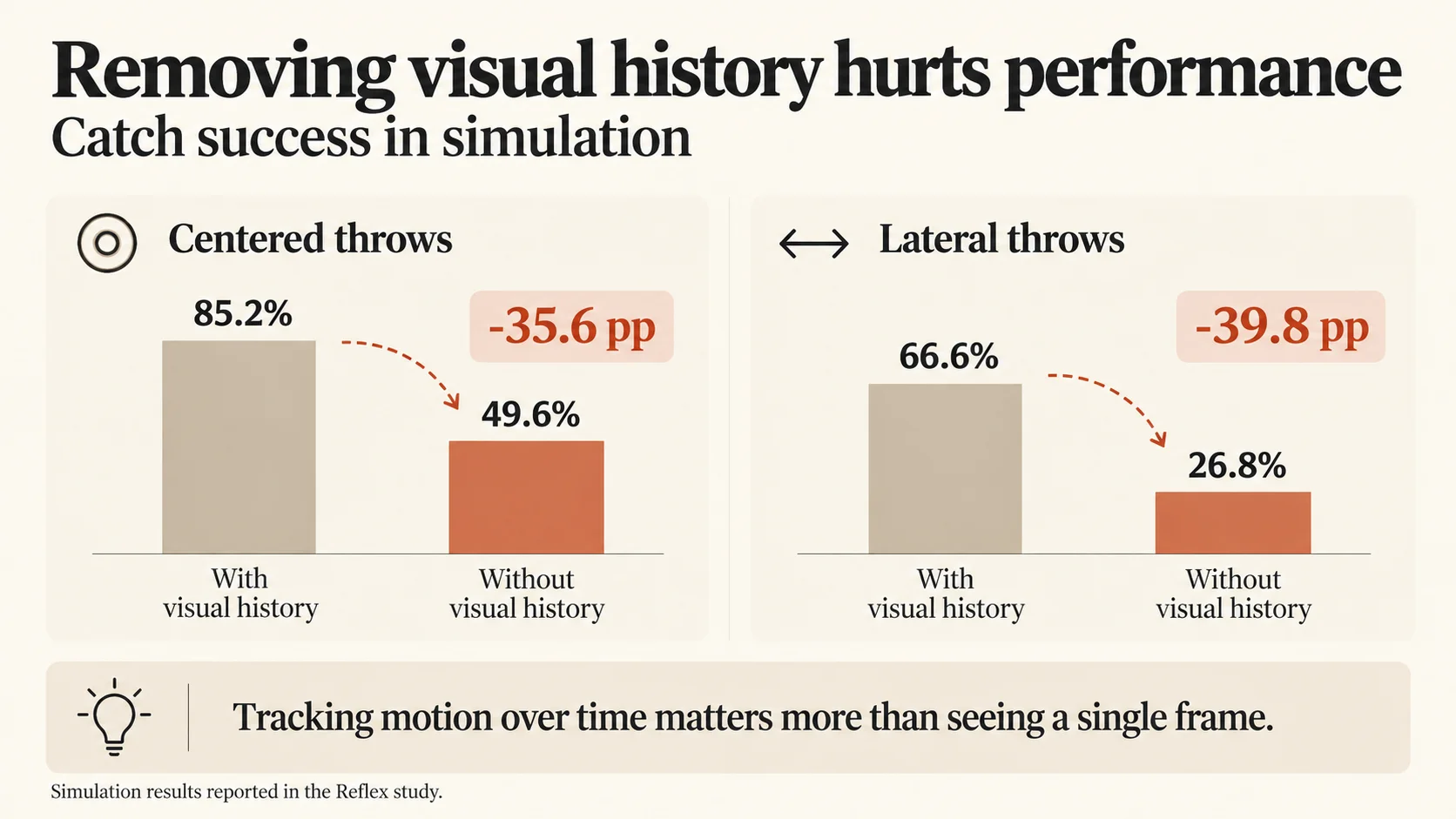
In simulation, when the researchers eliminated the visual history and let the system work with only a single instantaneous image, the catch rate dropped from 85.2% to 49.6% in centered throws.
In laterally displaced throws, the drop was even greater: from 66.6% to 26.8%.
These are reductions of 35.6 points and 39.8 points, respectively. The result shows that recognizing the box's current position is insufficient to perform the task with the same effectiveness. The robot needs to track its movement and anticipate where contact will occur.
In the main evaluation in simulation, the complete system achieved 85.7% success in 3,840 throws, performance close to the 87.9% obtained by a configuration that received privileged information about the object.
The proximity between the results suggests that the visual model managed to recover much of the information necessary for body control. This, however, does not mean that the same precision was reproduced in physical tests.
Catching the box is only part of the challenge
The researchers also demonstrated a more complex sequence: the Unitree G1 would catch a box, walk while carrying the object, hand it to a person and return to the starting position.
To perform this sequence, Reflex was combined with another controller responsible for locomotion and delivery.
The result exposed an important limitation. Of the 20 attempts made, only five completed all the stages, a success rate of 25%.
The research also presents statistical restrictions. With only 20 trials per condition in the physical experiments, the observed rates have considerable uncertainty intervals, which can reach approximately 20 points, plus or minus.
Another difficulty lies in visual perception at greater distances. In simulated tests, precision fell significantly with throws longer and faster than those used in visual training. Expanding that data improved the results in simulation, but this improvement has not yet been validated on the physical robot.
The work remains available as a preprint, with no independent validation identified.
Reflex, therefore, does not demonstrate that humanoids can already manipulate thrown objects with general reliability. Its most relevant result is another: a robot managed to combine its own vision, trajectory prediction and coordinated whole-body movements to react to an object in approximately one second, a fundamental capability for more dynamic physical interactions.