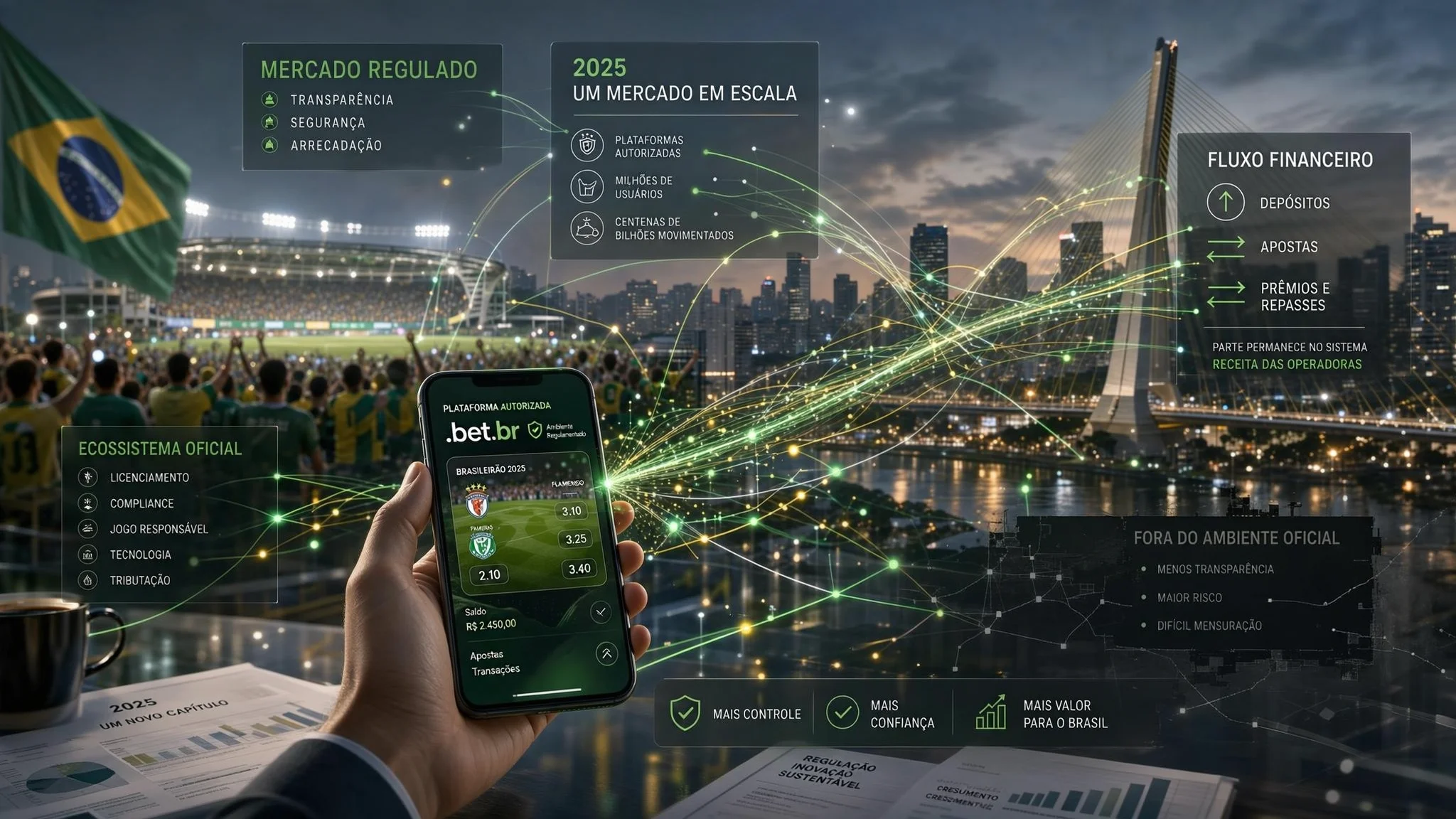
The betting operators authorized by the federal government moved R$ 220.6 billion in 2025, the 1st full year of the regulated market in Brazil. Of that total, R$ 36.9 billion remained as gross gaming revenue (GGR) of the operators, according to preliminary data from the Ministério da Fazenda obtained through the Lei de Acesso à Informação.
The GGR corresponded to 16.7% of the volume moved, while R$ 183.7 billion was allocated to the payment of prizes and withdrawable bonuses. The total of R$ 220.6 billion also includes amounts that returned to the platforms in new bets during the users' journey, and not only deposits of new money.
The numbers are monitored by the Secretaria de Prêmios e Apostas (SPA) through the Sistema de Gestão de Apostas (Sigap) and may still be revised during the verification and consolidation process.
The regulated fixed-odds betting market officially began national operations on January 1, 2025, when authorized companies started using websites with the .bet.br domain.
Estimate via Pix reaches R$ 350.97 billion
The Finance Ministry's numbers contrast with a survey by the Comitê Nacional de Secretários de Fazenda dos Estados e do Distrito Federal (Comsefaz), which estimated R$ 350.97 billion the volume of Pix transfers associated with betting in 2025.
The study also calculated a net transfer of R$ 62.5 billion from households to the sector in the period.
The difference of approximately R$ 130.4 billion relative to the R$ 220.6 billion recorded by the Finance Ministry, however, cannot be directly interpreted as money destined for illegal betting operators.
The surveys use different methodologies. The Finance Ministry works with information reported by authorized companies to Sigap. Comsefaz, in turn, used aggregated data from the Banco Central and estimated how much of the transfers to companies classified in the arts, culture, sports and recreation segments could be related to betting.
Illegal market complicates comparison
A survey by LCA Consultoria Econômica, with data from Instituto Locomotiva and support from the Instituto Brasileiro de Jogo Responsável (IBJR), estimated in 2025 that between 41% and 51% of the Brazilian betting market operated outside the regulated environment.
The survey, however, does not represent a direct measurement of clandestine operations by the government, and therefore does not allow the difference between the Finance Ministry and Comsefaz to be automatically attributed to illegal platforms.
In an update released in August 2026, the estimate of the clandestine market's share fell to 38% to 44%, still at a level considered high by the survey.
ANJL contests Comsefaz's calculation
The Associação Nacional de Jogos e Loterias (ANJL) contested the methodology used by Comsefaz and rejected the interpretation that the R$ 62.5 billion would represent exclusively Brazilian losses with betting.
According to the entity, the analyzed data cover transfers to companies in four economic segments — arts, culture, sports and recreation — which include activities other than betting.
The association also questioned the period analyzed and stated that factors such as the increase in banking access and the expansion of Pix for different types of payments may have influenced the results.
October saw the highest activity
October was the month with the highest activity on authorized platforms in 2025. The period coincided with the final stretch of the Campeonato Brasileiro and with decisive stages of the Libertadores and the Copa Sul-Americana.
On average, 9.25 million people bet per month, with a peak of 10.82 million in October. Over the course of the year, approximately 25 million Brazilians placed bets on regulated platforms.
The numbers show the scale achieved by the Brazilian market just one year after the start of regulation, but also highlight the difficulty of precisely measuring how much money still circulates outside authorized platforms.