
The Federal Reserve has begun transforming the GENIUS Act into an operational path for American banks to issue stablecoins. The proposal published in the Federal Register this Tuesday, September 29, defines how state member banks of the Fed may request authorization to create issuing subsidiaries. But the regulatory design indicates that having legal permission to enter does not mean that all banks will have the economic conditions to do it.
The central question becomes less who is authorized to issue and more who can sustain sufficient capital, reserves, liquidity, technology, compliance, and supervision to operate a competitive stablecoin. And the Fed itself recognizes that, at least initially, the most likely candidates are larger institutions.
The real cost starts before the first stablecoin
The proposed process requires the bank to present a business plan, governance structure, third-party relationships, distribution model, composition and management of reserves, financial projections for three years, and policies for redemptions, custody, processing, reconciliation, sanctions, and anti-money laundering. The Fed may also request additional information when it considers it necessary to assess the safety of the operation.
In isolation, completing the application does not appear to be the main barrier. The Fed itself estimates about 80 hours of work to meet the formal requirements of the application. The problem lies in the infrastructure that must exist behind the documents submitted.
In a parallel proposal, the Fed establishes that stablecoins supervised by the Board must remain backed by identifiable reserves of at least one-to-one. The issuer must have systems capable of monitoring the value of those reserves and demonstrate operational capacity to access them and convert them into liquidity when necessary.
Redemptions, under the proposal, must occur in up to two business days, except for specific situations determined by the regulator. This deadline increases the importance of liquid reserves, rapid access to the financial system, and operational processes prepared to absorb peaks in conversion requests.
Capital creates a barrier that does not appear in the text of the GENIUS Act
The proposed prudential regulation also introduces capital requirements for credit risk, counterparty risk, assets outside reserves, and operational losses. For new issuing subsidiaries, the Fed also proposes an initial floor of US$ 5 million during the first three years, subject to the greater of that limit and the capital calculated by the operation's actual risk.
US$ 5 million is not, by itself, an obstacle for much of the American banking sector. But the amount does not capture the necessary investments in compliance, reserve management, technology, auditing, security, blockchain integration, transaction monitoring, and redemption capacity.
That is why the Fed itself states that it expects the first interested banks to be larger institutions, with the compliance infrastructure and capital necessary to sustain issuance. For its regulatory analysis, the Board estimates that only five to ten state member banks of the Fed may initially request authorization.
This is an important signal about the practical effect of the GENIUS Act. The law opens the banking market to stablecoins, but the first competition cycle may be much more concentrated than the number of eligible banks suggests.
Large banks are already choosing shared scale
Market behavior reinforces that reading. A group of 21 financial institutions, including Bank of America, Citi, Goldman Sachs, Wells Fargo, PNC, and other global institutions, announced this month the intention to jointly launch a dollar stablecoin in the first half of 2027. The project intends to operate in compliance with the GENIUS Act.
The consortium model allows sharing infrastructure, liquidity, distribution, and regulatory costs, instead of each bank trying to individually build a stablecoin with enough scale to compete.
The Fed itself appears to anticipate this structure. The proposal specifically asks how the analysis of consortia formed by banks subject to different regulators should work and what information would be necessary to evaluate shared issuance structures.
This creates a possibility different from the simple proliferation of hundreds of bank currencies: some stablecoins shared by large financial groups, accompanied by banks that use the infrastructure without necessarily becoming independent issuers.
For smaller banks, infrastructure may be worth more than issuance
There are concrete signs of this second route. In September, Coinbase announced integrations with Stablecore and Moov aimed at bringing stablecoin-related services to regional banks, community banks, and credit unions. The two initiatives say they can potentially reach thousands of institutions without requiring each one to build all the digital infrastructure internally.
Citi also expanded its partnership with Coinbase this week. The structure allows corporate clients to accept stablecoin payments while conversion and settlement occur through the two companies' infrastructure, without the merchant needing to directly hold or manage the digital assets.
This model shows how regulatory requirements can also benefit providers of infrastructure, custody, compliance, payments, and integration between banks and blockchains. Institutions without enough scale to justify an issuing subsidiary will still be able to offer stablecoin-based products through partners.
The GENIUS Act, therefore, may increase banks' participation in the ecosystem even without turning every bank into an issuer.
Tether and Circle still have an advantage that is difficult to rebuild
The entry of banks also does not mean that current leaders automatically lose ground. The market remains heavily concentrated. Recent data from DefiLlama puts the total value of stablecoins close to US$ 306 billion, with about US$ 184 billion in USDT and US$ 75 billion in USDC. Together, the two coins represent approximately 84% of that market.
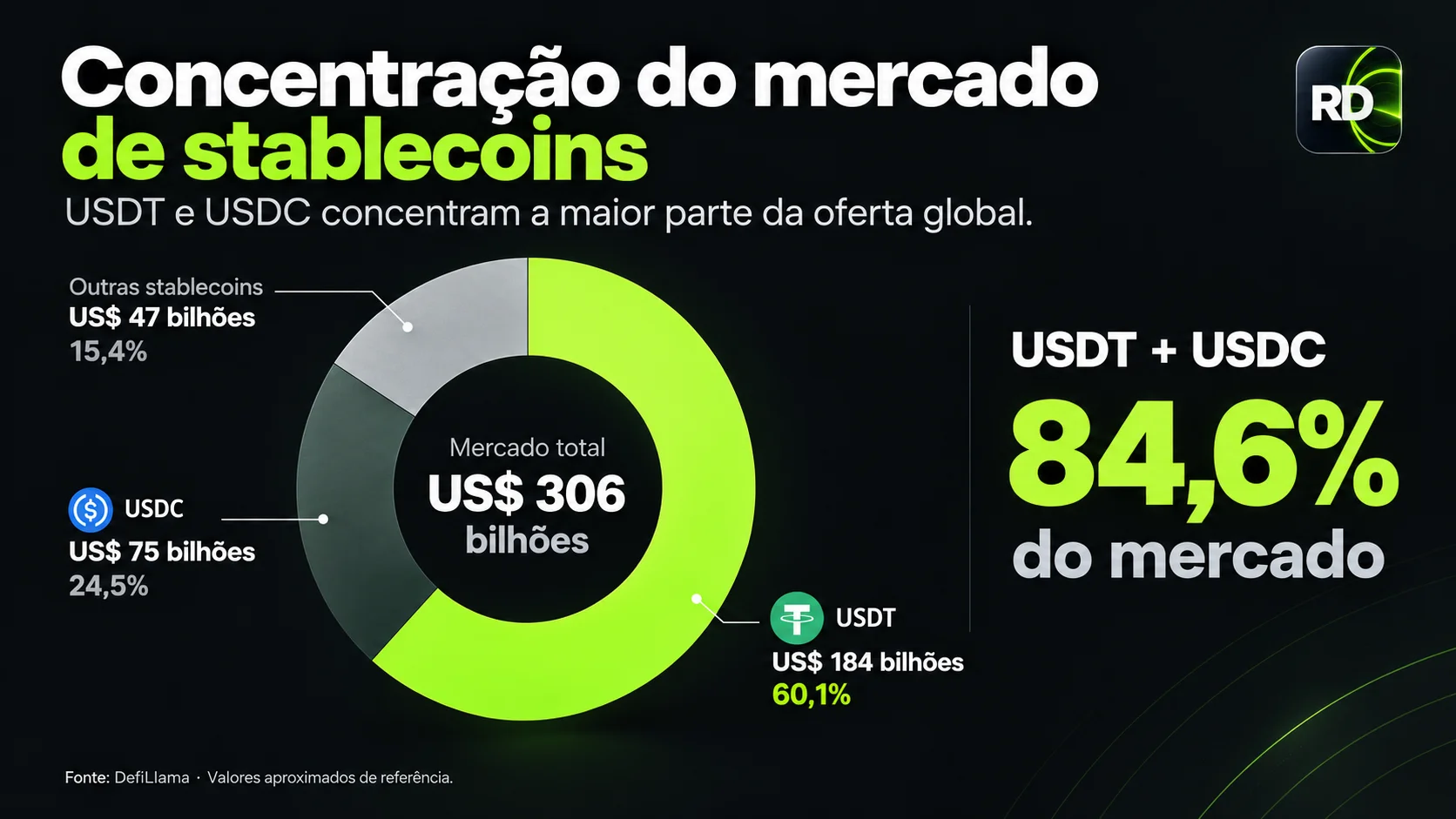
That scale produces advantages that a new bank stablecoin does not receive just by obtaining regulatory authorization: liquidity on exchanges, integration with wallets, presence on multiple blockchains, depth in secondary markets, and an existing user base.
Banks enter with other advantages. They already have corporate clients, payment systems, regulatory controls, access to traditional liquidity, and relationships capable of turning a stablecoin into part of treasury services, international trade, and business payments.
Competition may, therefore, occur less around who can create a token and more around who can put it into financial flows that already move large volumes.
The opening exists, but scale should define the first winners
The Fed proposal is still in public consultation until November 30, 2026, so specific requirements may change before the final version. The GENIUS Act also provides that a substantially complete application be decided within up to 120 days, with automatic approval if the Board does not act within that period.
What is already clearer is the economic structure that is beginning to emerge. The GENIUS Act removes a major legal uncertainty and creates a formal route for banks to enter stablecoin issuance. But the Fed is building that route with requirements closer to those of critical financial infrastructure, not those of a simple digital product.
This tends to separate three groups: large institutions capable of issuing directly, banks that will share scale through consortia, and smaller institutions that may consume stablecoins as infrastructure provided by third parties.
The next relevant indicator will not be only how many banks request authorization. It will be how many will actually choose to issue their own coin, how many will join consortia, and how many will decide that integrating existing stablecoins is more economically efficient than competing directly with them.