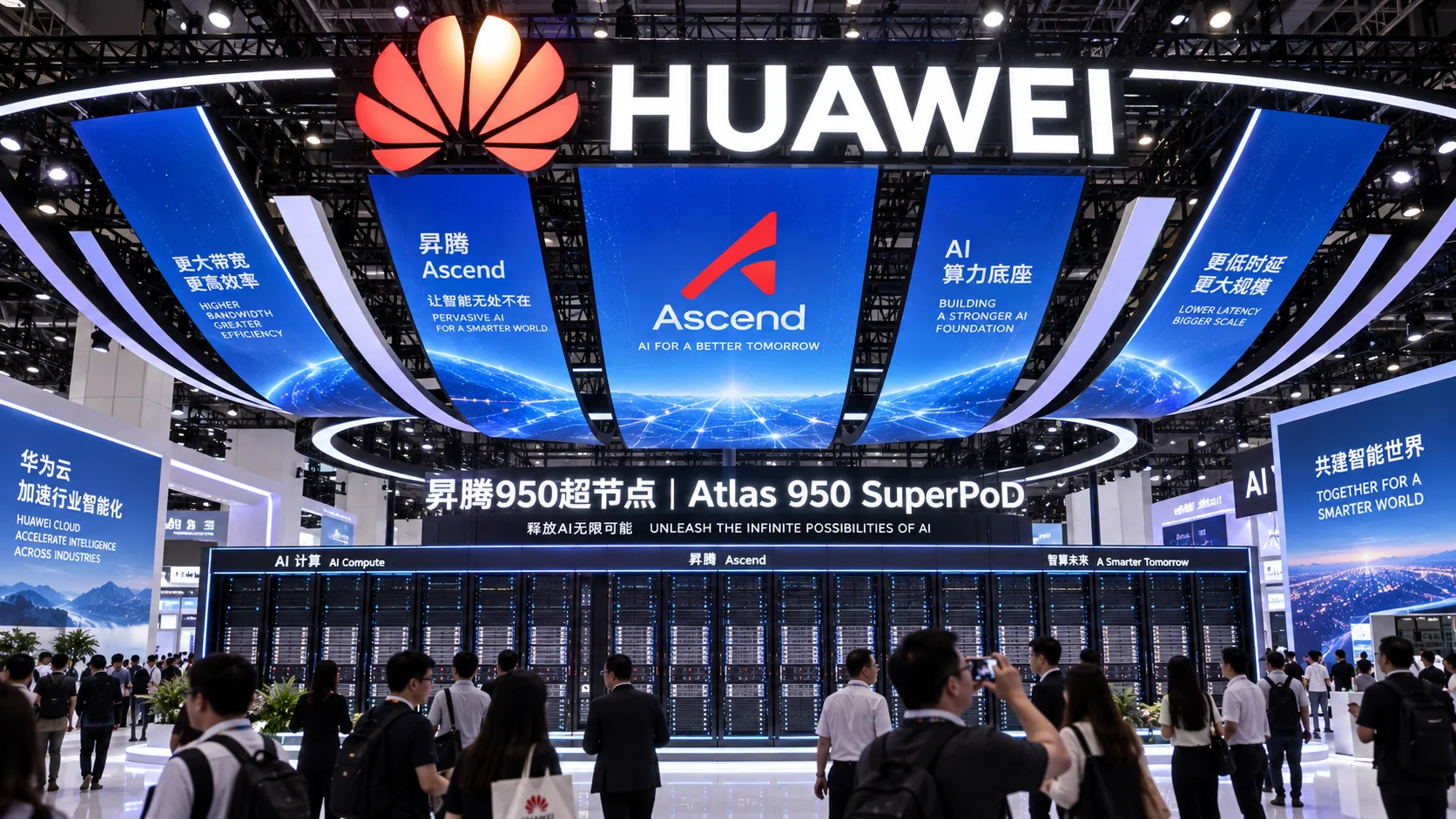
Huawei will bring forward the launch of its next generation of artificial intelligence chips and keep the interconnection of large volumes of processors at the center of its strategy to compete in AI infrastructure. The company announced this Thursday (17), during Huawei Connect 2026, in Shanghai, that the Ascend 960DT will arrive in the first quarter of 2027, followed by the Ascend 960PR in the third quarter.
The 960DT, aimed at model training, was previously scheduled for the end of 2027 and had its launch moved up by about nine months. Huawei says the chip will have twice the performance of the previous generation. The 960PR, aimed at inference, will also arrive ahead of the previous schedule.
The acceleration comes as domestic demand for Huawei's AI equipment exceeds its current production capacity. American restrictions on the export of advanced chips and semiconductor manufacturing equipment have also reduced Chinese companies' access to Nvidia's most advanced accelerators, increasing pressure to develop local alternatives.
UnifiedBus widens the dispute beyond the performance of each chip
A central part of this strategy is UnifiedBus, an interconnection technology developed by Huawei to make large quantities of processors operate as a single system. David Wang, the company's rotating chairman, said the technology will be a key part of the company's next generation of AI systems.
The approach allows Huawei to pursue more computing capacity by increasing the number of connected chips, instead of relying only on the individual performance of each accelerator. This path has gained importance for Chinese manufacturers given the limitations on access to the most advanced foreign chips, although its efficiency depends on high-bandwidth, low-latency connections between processors.
Huawei says it has developed 11 semiconductors compatible with UnifiedBus for its large systems. Its largest superclusters will be able to bring together up to 1 million AI processors, while more than 1,000 supernodes have already been shipped to more than 370 customers. The company did not disclose the buyers or detail the distribution of these systems.
UnifiedBus is not a technology introduced for the first time this year. Huawei made its specifications public in 2025 and had already detailed an Atlas 960 SuperCluster planned with more than 1 million NPUs, in addition to an Atlas 950 with more than 500,000 units. At the time, the company said the architecture was a response to China's limited access to the most advanced semiconductor manufacturing processes.
With the new chips, Huawei intends to maintain an annual update cycle for the Ascend family. The company expects the Ascend 970 for 2028 and the 980 for 2029, extending a strategy that combines new accelerators, interconnection and ever-larger systems to reduce the gap with infrastructure dominated by Nvidia.