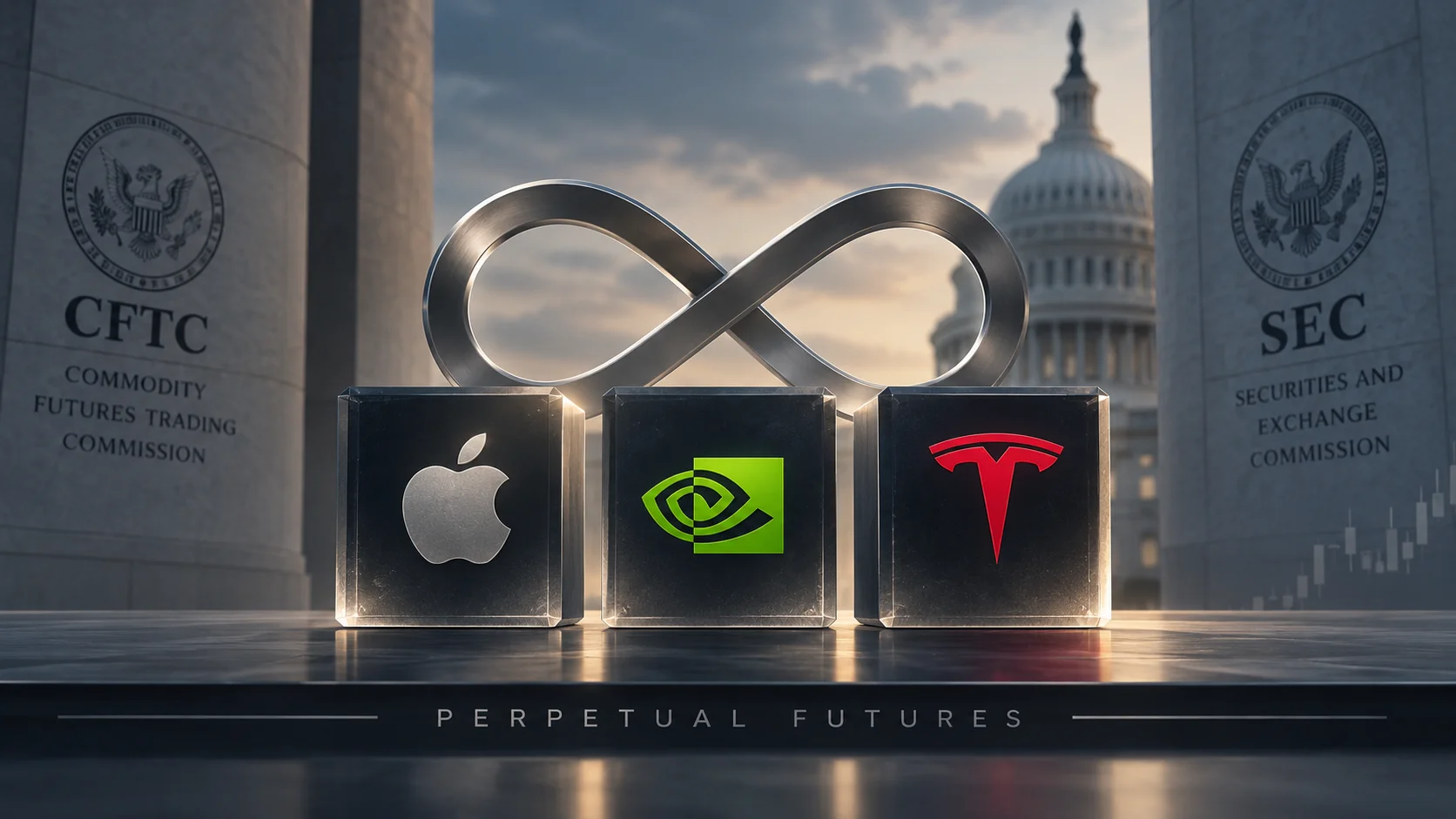
The Kalshi formalized its plan to offer perpetual futures tied to individual stocks in the United States. The operator presented new rules to the Securities and Exchange Commission (SEC) and submitted the framework to the Commodity Futures Trading Commission (CFTC), which still needs to authorize the contracts.
The company plans to launch about 60 perpetuals on stocks and ETFs, including Apple, Nvidia and Tesla, according to people familiar with the project who spoke to the Wall Street Journal. If approved, the products would bring to the U.S. regulated market a type of derivative that gained popularity mainly in the cryptocurrency sector.
Unlike traditional futures, perpetuals do not have an expiration date. Under the proposed structure, long and short positions would make periodic payments of funding to keep the contract price close to that of the reference stock. Settlement would be in cash, with no delivery of the shares.
Kalshi also set requirements for eligible assets. The stocks must have a minimum market capitalization of US$ 100 billion, average daily trading volume of at least US$ 450 million in the previous six months and sufficient liquidity to support the contracts.
Trading for 23 hours and minimum margin of 15.5%
The perpetuals may be traded from 18:00 on Sunday to 17:00 on Friday, U.S. Eastern Time, with a one-hour daily pause. In practice, the market would operate 23 hours a day, five days a week.
For clients, the proposal establishes a minimum margin equivalent to 15.5% of the position value. Trading must also be halted when there is a regulatory suspension in the stock used as reference.
Implementation, however, depends on the CFTC. The rule change submitted to the SEC provides for it to take effect on November 2, 2026, or later if the derivatives regulator's authorization occurs after that date.
Kalshi has already received CFTC authorization for a Bitcoin perpetual contract, but the regulator indicated that new products of this type need to be evaluated according to the asset class.
The initiative comes as other platforms try to expand the American perpetuals market. The Coinbase also submitted documentation to offer contracts tied to individual stocks, increasing the competition to bring this derivative model to the U.S. regulated environment.