
Marketing and sales funnels are useful because they turn a complex buying journey into a measurable operating model. They are not a claim that every customer moves through the same linear sequence. They are a way to see where attention becomes intent, where intent becomes revenue, and where the system loses qualified people along the way.
The most useful funnel is not the one with the most stages. It is the one that helps the team make better decisions.
What a funnel should do
A funnel should answer four questions:
- How does the right audience enter the system?
- What evidence shows that intent is increasing?
- Where do qualified prospects or customers drop out?
- Which stage is currently limiting growth?
Traditional marketing models often describe awareness, consideration and conversion. Sales teams may use lead, marketing-qualified lead, sales-qualified lead, opportunity and closed-won. Product-led businesses may focus on visit, signup, activation, paid conversion and retention.
All of these can work if the definitions are explicit.
The problem begins when marketing and sales use the same words differently.
Define stages by observable behavior
Avoid vague stages such as “interested” unless the organization can define what that means.
A B2B funnel might use:
Qualified audience
A visitor or account matches the priority segment and has reached the business through a relevant channel.
Engaged evaluator
The prospect has consumed high-intent content, returned repeatedly, used a calculator, attended a demo, compared plans or otherwise signaled evaluation.
Lead
The person has provided identifiable information.
Qualified lead
The lead meets explicit fit and intent criteria.
Opportunity
Sales has validated a real buying process.
Closed-won
A commercial agreement has been completed.
Activated customer
The customer has reached the first meaningful value milestone.
Retained or expanded account
The customer renews, increases usage, buys more or refers others.
The stage definitions should be based on events that can be tracked in the CRM, product analytics platform, ecommerce platform or web analytics system.
Marketing funnel and sales funnel should connect
A common organizational mistake is to treat the marketing funnel and sales funnel as two unrelated systems.
Marketing optimizes cost per lead. Sales optimizes win rate. Nobody owns the handoff.
The result can be impressive top-of-funnel metrics and disappointing revenue.
The shared funnel should connect:
audience → engagement → lead → qualification → opportunity → revenue → activation → retention
Not every business needs every stage, but the transition logic should be visible.
For each transition, define:
- owner;
- entry criteria;
- exit criteria;
- expected time;
- conversion rate;
- data source;
- next action.
That makes the funnel operational rather than decorative.
Start optimization at the constraint
Suppose a business has:
- 100,000 monthly visits;
- 3,000 leads;
- 900 qualified leads;
- 180 opportunities;
- 36 new customers.
The conversion rates are:
- visit → lead: 3%;
- lead → qualified: 30%;
- qualified → opportunity: 20%;
- opportunity → customer: 20%.
It is tempting to focus on the 3% visit-to-lead rate because it appears low. But the largest economic opportunity may be elsewhere.
If lead volume is already sufficient and sales capacity is constrained, increasing lead conversion may create more unworked leads. If opportunity quality is weak, qualification may be the more important stage. If customers churn quickly, no acquisition optimization will fix the underlying economics.
Funnel optimization should start with the binding constraint, not the most visually dramatic percentage.
Measure volume, conversion, velocity and value
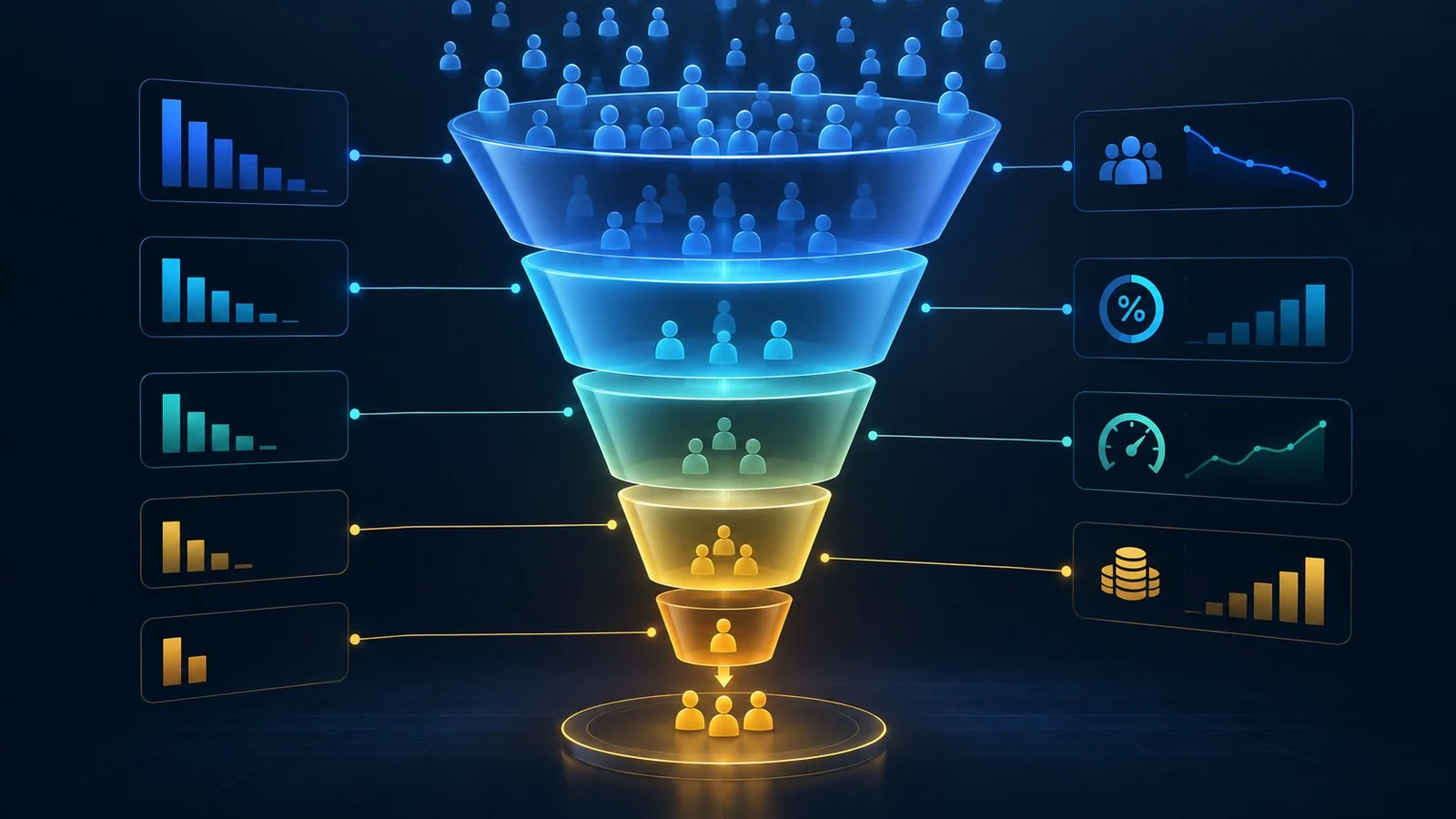
A complete funnel view uses four dimensions.
Volume
How many entities reach each stage?
Examples:
- sessions;
- accounts;
- leads;
- opportunities;
- customers.
Conversion
What percentage move to the next stage?
Formula:
`stage conversion rate = next-stage volume / current-stage volume`
Velocity
How long does movement take?
Examples:
- days from first visit to lead;
- days from lead to opportunity;
- sales cycle length;
- time to activation.
A funnel can have a healthy conversion rate but poor velocity. That affects cash flow and planning.
Value
How economically valuable are the entities moving through the funnel?
Examples:
- average contract value;
- gross margin;
- expected LTV;
- contribution margin;
- retained revenue.
This prevents the team from optimizing for low-quality volume.
Segment the funnel
Aggregate conversion rates hide useful information.
Segment by:
- acquisition channel;
- campaign;
- landing page;
- geography;
- device;
- ICP tier;
- product category;
- customer size;
- new vs. returning;
- content consumed;
- sales motion.
A 4% overall conversion rate might contain one segment converting at 12% and another at 0.7%.
The purpose of segmentation is not to create dozens of dashboards. It is to reveal where the funnel behaves differently enough to require a different decision.
Optimize the top of the funnel for qualified demand
Top-of-funnel work is not simply traffic generation.
A strong acquisition system asks:
- Are we reaching the right audience?
- Are we creating or capturing relevant demand?
- Does the message accurately describe the value?
- Are we attracting prospects that downstream teams can convert?
High traffic with poor downstream quality can increase CAC even if CPC or cost per visit looks efficient.
This is why channel metrics should be connected to downstream outcomes.
Paid search, for example, should not be evaluated only by click-through rate. Search terms, qualified conversion, revenue, margin and new-customer quality matter more.
Optimize the middle of the funnel for clarity and proof
The middle of the funnel is where prospects evaluate risk.
Useful assets include:
- product comparisons;
- pricing explanations;
- case studies;
- calculators;
- demos;
- implementation guides;
- objection handling;
- proof of outcomes;
- security or compliance documentation.
The goal is to reduce uncertainty.
Many businesses produce large amounts of awareness content but comparatively little decision-support content. That creates a funnel with broad reach and weak progression.
Optimize conversion by reducing unnecessary friction
Friction is not always bad.
A longer form can reduce raw conversion while increasing lead quality. A qualification step can discourage poor-fit prospects. A required credit card can decrease trials while increasing activation discipline.
The correct question is:
Does this friction improve the economics of the system?
Test forms, checkout, pricing presentation, calls to action, onboarding and sales handoffs using downstream metrics, not only immediate conversion.
Extend the funnel beyond purchase
The purchase is not the end of the economic journey.
Post-purchase stages often determine whether acquisition is sustainable:
- onboarding;
- activation;
- repeat usage;
- renewal;
- repeat purchase;
- expansion;
- advocacy.
If the business spends aggressively to acquire customers who do not activate or retain, CAC can appear acceptable before the full economics become visible.
A useful funnel therefore connects acquisition with lifecycle behavior.
Use analytics events carefully
In GA4, events can represent interactions such as page views, clicks, signups, purchases and other user actions. Recommended and custom events can support a funnel when they are implemented consistently.
For example:
- `view_pricing`
- `generate_lead`
- `sign_up`
- `begin_checkout`
- `purchase`
Business-specific events may also be needed.
Event governance matters. Teams should maintain a measurement dictionary with:
- event name;
- definition;
- trigger;
- parameters;
- owner;
- source system;
- related funnel stage.
Without this, different reports can describe the same behavior differently.
Treat attribution as directional evidence
A customer may encounter multiple touchpoints before converting.
Attribution attempts to distribute credit across those touchpoints. Google Analytics, for example, supports multiple attribution approaches including data-driven attribution and last-click variants.
Attribution can help compare channel roles, but it should not be mistaken for perfect causal measurement.
Use attribution together with:
- incrementality tests;
- geo experiments;
- holdouts;
- cohort analysis;
- branded vs. non-branded demand;
- direct response data;
- CRM outcomes.
The more consequential the budget decision, the more important it is to triangulate.
Funnel math for planning
Funnels can also be used in reverse.
Suppose the business wants 100 new customers per month.
If:
- opportunity → customer = 25%;
- qualified lead → opportunity = 20%;
- lead → qualified lead = 40%;
- visit → lead = 4%;
then the business needs approximately:
- 400 opportunities;
- 2,000 qualified leads;
- 5,000 leads;
- 125,000 qualified visits.
This model is simplified, but it exposes assumptions.
If the required traffic is unrealistic, the team can ask which conversion stage must improve or whether average deal value must rise.
Build service-level agreements between teams
A funnel becomes significantly more useful when transitions have operating rules.
Examples:
- sales contacts high-intent inbound leads within a defined period;
- marketing provides source and intent context;
- sales returns disposition data;
- lifecycle marketing receives activation status;
- product analytics feeds adoption data back into segmentation.
This creates a learning loop.
Without feedback, marketing cannot distinguish poor targeting from poor follow-up.
Common funnel mistakes
Measuring only the top
Traffic and leads rise while revenue quality deteriorates.
Overcomplicating stages
The funnel has fifteen stages that nobody uses consistently.
Changing definitions midstream
Historical comparisons become unreliable.
Ignoring time
A “converted” customer may have taken six months to progress.
Optimizing each stage independently
Improving one conversion rate harms downstream quality.
Ending at purchase
Retention and expansion are absent from the model.
Funnel optimization checklist
For every major stage, document:
- definition;
- owner;
- source system;
- stage volume;
- conversion rate;
- median time to next stage;
- quality or value metric;
- common drop-off reason;
- active experiment.
Then ask:
- Where is the current constraint?
- Which segment performs materially differently?
- Is the issue volume, conversion, velocity or value?
- Which assumption can we test?
- What downstream metric could be harmed by the optimization?
A funnel is most valuable when it stops being a picture and becomes a shared decision system. The objective is not to force every customer into a linear model. It is to make the mechanics of growth visible enough to improve them.