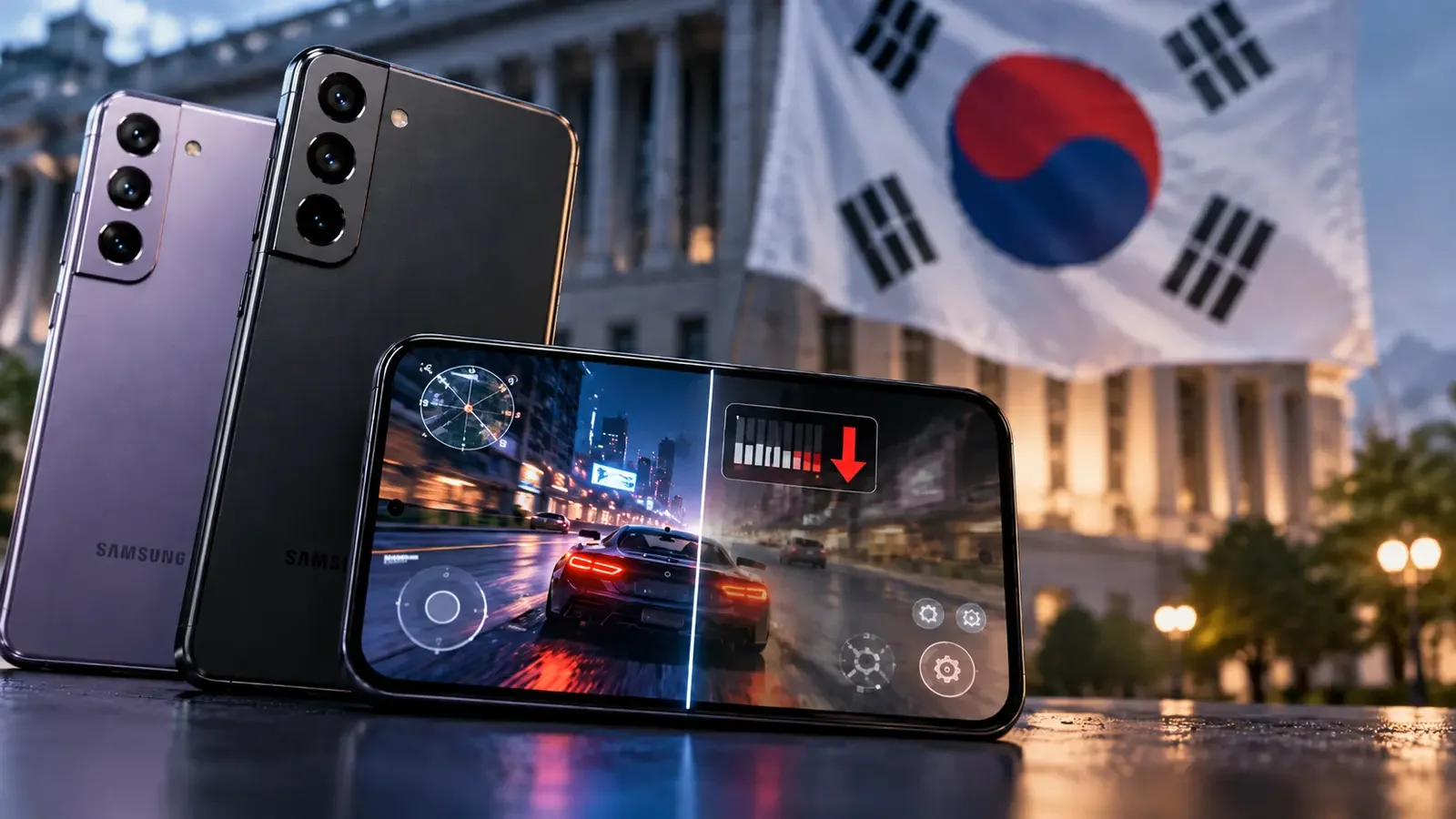
Samsung received a provisional fine of 20.1 billion won (about US$ 15.1 million) in South Korea for promoting the performance of its Galaxy devices without disclosing that processing was automatically limited during certain games. The decision was announced this Tuesday (27) by the Korea Fair Trade Commission (KFTC).
The penalty involves the smartphones Galaxy S21 and S22, launched in 2021 and 2022, and the Galaxy Tab S8 tablets. According to the regulator, the manufacturer highlighted the processing capacity and gaming experience of these devices, but omitted restrictions imposed by the Game Optimizing Service (GOS) software.
GOS was developed to control heating and power consumption during games. The investigation, however, concluded that certain configurations reduced the maximum CPU and GPU capacity as soon as demanding games were started, regardless of temperature or the device's conditions.
This limitation could cause crashes, delays in responding to commands, and reduced graphics quality, according to the KFTC.
Between 2021 and 2022, Samsung used campaigns that emphasized processor speed and the smoothness of 120 Hz displays. For the regulator, the absence of information about the restrictions impaired consumers' ability to assess the products' actual performance before purchase.
Fine was reduced after software changes
The penalty came in below the amounts initially considered by investigators, which ranged from 32.2 billion to 64.4 billion won.
In setting the sanction, the KFTC considered that Samsung had adopted voluntary corrective measures. In March 2022, after user complaints, the company released an update that allowed the initial performance restrictions in demanding games to be disabled.
This correction helped reduce the severity classification of the violation and, consequently, the amount of the fine. The decision also includes an order to stop advertising practices considered misleading.
Samsung disputed the regulator's conclusion. The manufacturer argues that GOS was designed to prevent overheating and maintain a stable gaming experience during extended sessions, not to deceive consumers.
The company also noted that the lawsuits related to the case were closed without a final decision recognizing its liability for consumer compensation.
Samsung said it intends to challenge the sanction in court after reviewing the KFTC's written decision.
The controversy began in 2022, when users discovered that certain games could not use all the processing capacity advertised for the devices. Four years later, the regulatory decision closes an administrative stage of the case, while the court challenge may still determine whether the penalty is maintained.