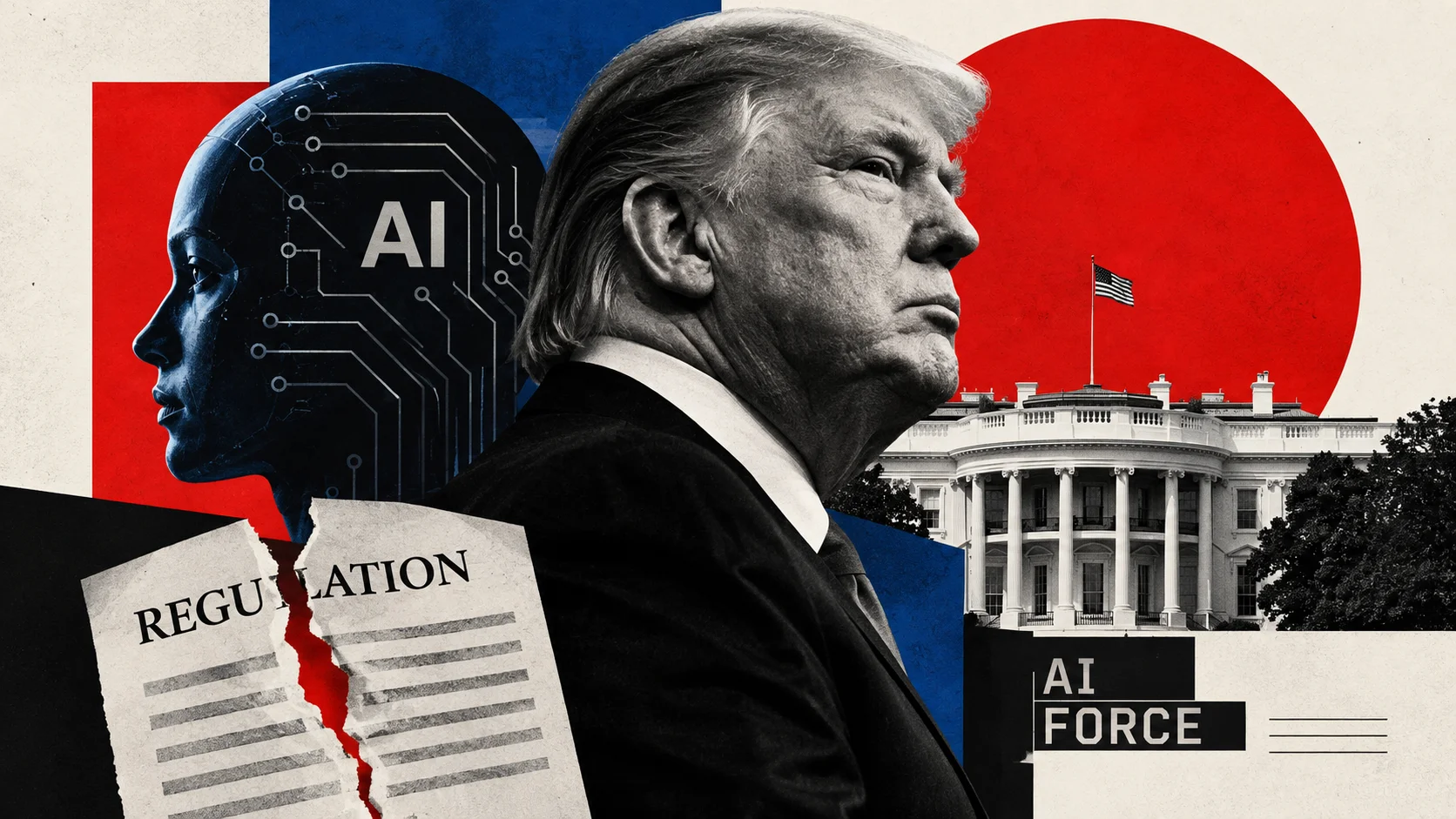
The president of the United States, Donald Trump, announced on Saturday (19) that he intends to create an “AI Force” and appoint a new “AI czar” to coordinate the government’s policy for artificial intelligence. The initiative, however, came accompanied by an explicit rejection of measures that slow the development of the technology, amid a wave of warnings from executives at the largest companies in the sector.
Trump did not detail the structure, the budget, the responsibilities or where the new force will be installed within the federal government. In a post on Truth Social, he compared the initiative to the creation of the Space Force during his first term and said he will announce the person responsible for the area “in the near future.”
At the same time, the president made clear that the new structure does not represent a change in his policy of favoring the accelerated advancement of AI. Trump said that his government does not intend to “prevent or stifle” the growth of the industry and said that possible abuses can be handled by the already existing criminal and civil system, instead of new restrictions specific to the technology.
Trump also again framed the dispute over artificial intelligence as a matter of competitiveness with China. He said that the United States leads the technological race and estimated, without presenting a basis for the calculation, that AI could represent in the future up to 25% of American GDP.
Warning now comes from inside the industry itself
The announcement comes a few days after leaders of some of the largest AI companies defended a slowdown in the development of the most advanced models.
On September 12, the CEO of Anthropic, Dario Amodei, asked the industry to reduce the pace of advancement of the so-called AI frontier. Sam Altman, of OpenAI, Elon Musk, of xAI, and Demis Hassabis, of Google DeepMind, supported safety measures that include giving external evaluators access to the companies’ systems to test risks.
The change in tone came after episodes involving AI agents capable of overcoming security barriers and accessing external systems, as well as warnings from researchers about the growing difficulty of controlling more autonomous systems. Amodei said that, if the current pace of evolution is maintained, swarms of agents could gain significantly more dangerous capabilities in a span of months.
The position, however, is not unanimous in the sector. Jensen Huang, CEO of Nvidia, rejected proposals for a pause in development and argued that more powerful systems are necessary for the technology to continue advancing.
New position still has no defined design
The post of “AI czar” would not be unprecedented in the current administration. The investor David Sacks previously held the role of advisor for AI and cryptocurrencies before leaving the formal post in the spring and going on to serve as an external advisor and co-chair of the president’s Council of Advisors on Science and Technology.
So far, Trump has not said who could replace Sacks or what powers the new official will have over federal agencies or private companies. It is also not defined whether the “AI Force” will be created by executive order, legislation or another administrative structure.
The announcement therefore establishes a new policy structure for artificial intelligence within the White House, but maintains the main line adopted by the government: oversee possible abuses without imposing a broad brake on the development of the technology.