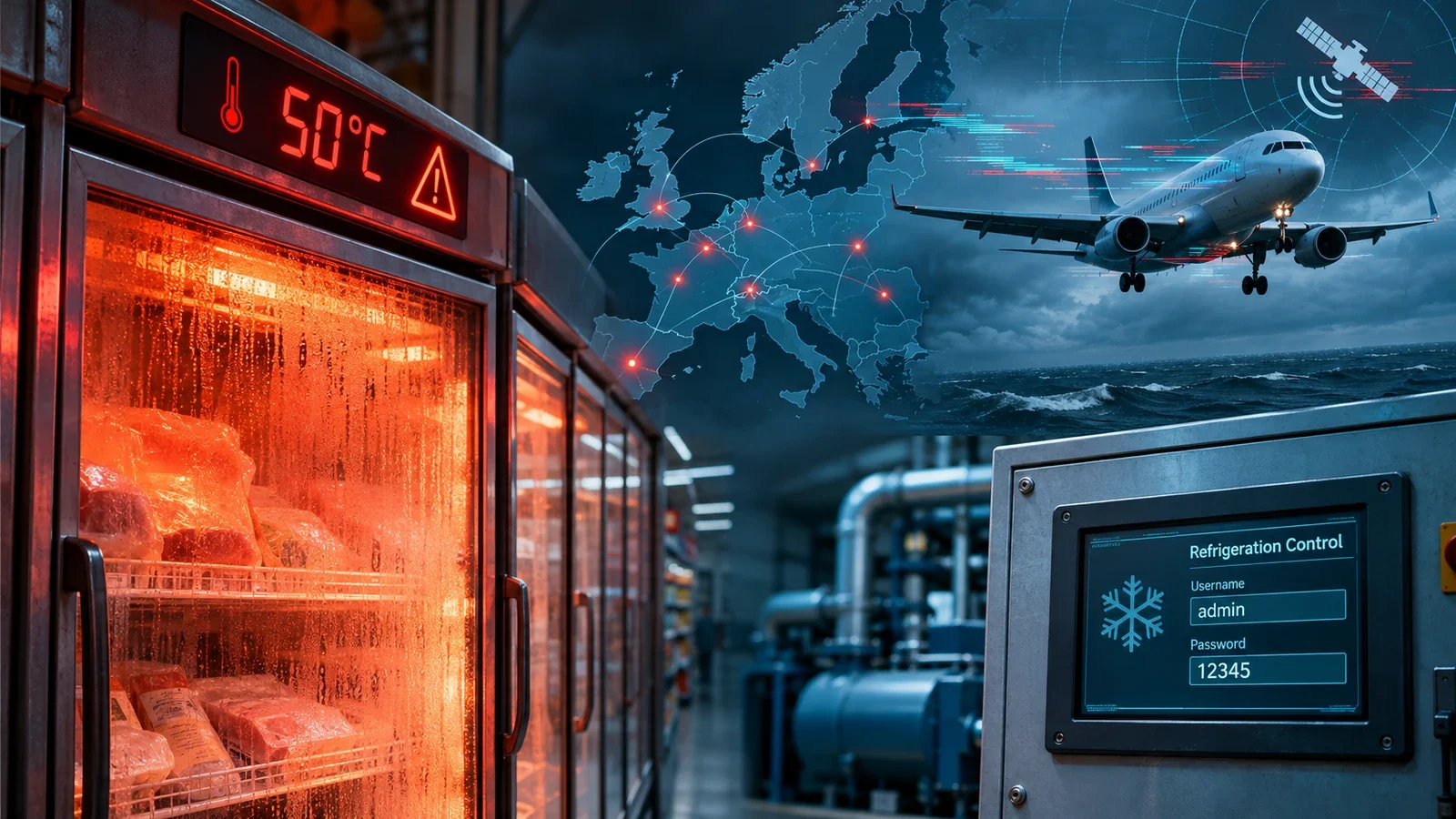
Overnight from November 2 to 3, freezers in European supermarkets began entering defrost mode without authorization. In some establishments, temperature controls were adjusted to as much as 50 °C, forcing employees to discard meat and frozen foods. The problem hit several countries and also reached blood banks in France.
The episodes are part of a survey by DigitalEurope, an association representing the European digital technology industry. Published by Euronews this Sunday (22), the inventory brings together 16 incidents recorded between October 18 and November 18, 2026, involving refrigeration systems, hospitals, financial institutions, energy companies, public agencies, and aviation.
There were 11 cyber incidents and five classified as physical actions. Although the cases caused financial losses, service interruptions, and operational risks, only three have had their authorship publicly attributed by authorities or researchers. There is no evidence that the 16 episodes were coordinated by the same group.
From supermarkets to blood banks: refrigeration became a target
The November wave hit supermarkets in Germany, Italy, the Netherlands, Belgium, Romania, and Sweden. There were also records in the United Kingdom and problems at blood storage facilities in France.
In Belgium, about 75 establishments were affected, including locations of the Delhaize, Carrefour, Intermarché, and Spar chains. Carrefour reported that 15 of its approximately 700 stores in the country had problems but remained open. In Sweden, locations of the ICA and Coop chains also had their refrigeration compromised.
The mechanism involved the remote alteration of equipment parameters, especially the improper activation of defrost cycles. Under normal conditions, this function removes accumulated ice from the systems. When activated for an extended period or accompanied by temperatures incompatible with preservation, it can render stored products unusable.
The problem had already appeared in France in October, before the period covered by the inventory. At the time, at least 350 supermarkets had their refrigeration systems manipulated, including Carrefour, Monoprix, Intermarché, and Coopérative U locations.
European Commissioner for Agriculture and Food Christophe Hansen classified the attacks as a deliberate attempt to harm the food supply chain. Despite this, there was no confirmed authorship for the November wave.
Hospitals, banks, and energy companies were also hit
The incidents involving digital systems were not limited to retail.
In Germany, the Greiz-Ronneburg district hospital identified a cyberattack on November 15. The compromise of its systems led to the temporary suspension of emergency department care, while police authorities and investigators analyzed the incident. The administration reported that patient safety remained preserved but advised people in emergency situations to seek care through the emergency center.
In Norway, energy company Equinor identified an attack against its internal technology systems on November 17. Corporate services were affected, but the company reported that oil and gas production had not been interrupted and that there were no indications of information theft.
Another case involved Femern Link Contractors (FLC), the main consortium responsible for building the Fehmarnbelt tunnel between Denmark and Germany. An official project update published on October 27 confirmed the theft of data, including personal information. The organization responsible for the project said it had not identified any compromise of its own systems.
Public agencies also appeared in the survey. At an unidentified European Union institution, human resources, payroll, and medical services systems became unavailable. In another incident, personal data of 18 high-ranking officials from Italy, Germany, and the Netherlands were published. In Romania, malicious software aimed at espionage was found in government email systems.
The financial sector recorded particularly high losses. In France, the bank Crédit Mutuel Arkéa suffered an attack that used an external vendor's platform to carry out fraudulent transfers, involving an estimated amount of more than €100 million. The institution reported that part of the funds had been blocked and that it was working to recover the amounts, without confirming a definitive loss equivalent to the total transferred.
In Italy, more than 700 customer accounts at a fintech had information exposed. In Denmark, a maritime transport group suffered a breach of an old system, with data extraction.
The defense industry also entered the inventory: in Germany, a manufacturer of military drones was hit through a compromised software update. The case shows a different type of intrusion, in which the compromise of a component distributed by third parties can open the way to target the organization that uses it.
GPS interference, bomb threats, and sabotage attempts
The five episodes not classified as cyberattacks show that the survey goes beyond computer intrusions.
On November 9, interference in satellite navigation signals affected approximately 80 aircraft over the Netherlands and areas near the North Sea. Seven flights approaching Schiphol Airport in Amsterdam had difficulties with GPS-dependent procedures.
The seven aircraft landed safely with support from air traffic control. The deliberate radio interference, known as jamming, was cited as a plausible explanation, but the exact origin of the signal and responsibility for the episode were not formally established.
In Moldova, the government temporarily closed its airspace on November 17 after identifying an attack drone heading toward the capital, Chișinău. President Maia Sandu denounced violations of airspace by Russian drones, in an episode directly related to tensions caused by the war in Ukraine.
Commercial aviation also faced a series of false bomb threats. More than 35 European flights were affected in early November, causing route diversions, aircraft inspections, emergency landings, and mobilization of security forces.
The remaining episodes involved sabotage attempts against physical infrastructure. In Estonia, authorities prevented an arson plan against a drone manufacturer. In Germany, another plan called for setting fires near a railway and a power transmission line.
Although the episodes were gathered in the same survey, their characteristics are different. GPS interference, a false bomb threat, and an attempted fire do not, by themselves, demonstrate the existence of a common command.
The password 12345 and the nearly 13,000 exposed refrigeration services
The mechanism of the attacks against freezers helps explain how equipment seemingly far from the world of digital security can become vulnerable.
Large refrigeration facilities use controllers that manage temperatures, defrost cycles, alarms, and operational records. The internet connection allows external technicians to monitor the equipment and perform maintenance without visiting each establishment.
Some of the affected systems used controllers from the Danish manufacturer Danfoss, including models from the AK-SM line. French authorities also identified equipment associated with the Copeland and Dixell platforms.
The problem involves a combination of administrative interfaces accessible via the internet, old firmware versions, equipment without security support, and factory credentials that remain in use. Among the examples identified were the username “Supervisor” and the password “12345”.
The security company Forescout published research on October 22 about the exposure of these devices. The survey found 12,976 observations of internet-accessible refrigeration management services, associated with 6,017 public IP addresses in 99 countries and territories.
Of these records, 7,075 corresponded to the Copeland/Dixell XWEB family and 4,697 to Danfoss StoreView services. The research also identified thousands of instances with software versions prior to fixes for known vulnerabilities.
The numbers, however, require a distinction: they represent services identified on the internet, not necessarily 12,976 individual controllers. Nor do they mean that all of them were breached.
One of the models involved, the Danfoss AK-SM 800, stopped receiving support in May 2021. For equipment in this condition, a conventional update may not be available, making isolation or replacement measures necessary.
Forescout recommends removing administrative interfaces from the public internet, using protected remote connections, eliminating shared credentials, and updating or replacing vulnerable equipment.
The investigation also exposed a management difficulty: refrigeration may be managed by a third-party company, belong to the supermarket, and use a network connection maintained by another team. When responsibilities are divided, there is not always a person responsible who has complete visibility into the system's security.
Only three of the 16 incidents have had their authorship publicly attributed
The most important data point in the inventory may be what remains unknown.
The authorship classification presented by DigitalEurope shows four distinct situations:
- 3 incidents publicly attributed by governments or researchers;
- 4 incidents claimed by the perpetrators themselves;
- 2 incidents with suspects identified but no formal attribution;
- 7 incidents with no responsible party identified.
A claim is not equivalent to proof of authorship. Likewise, the existence of suspects or technical indications does not allow concluding that a government or organization ordered a given operation.
In the case of the freezers, the British security company Lupovis said it had identified more than 276 access attempts carried out by 91 threat actors against test systems that simulated Danfoss controllers. The activity occurred over ten days, peaking on October 26.
Some of the connections were associated with hosting services previously used by Russian criminal groups. Xavier Bellekens, executive director of Lupovis, considered a state actor's participation possible given the concentration of activities in time. He himself stressed, however, that these indications do not prove Russian responsibility.
Other experts reached different assessments. Dan Cimpean, director of Romania's national cybersecurity authority, described the actions against refrigeration systems as relatively amateurish and said he did not suspect a state operation.
The absence of ransom demands in the freezer attacks increased doubts about their motivation. There was also no consensus among authorities on the classification of the episodes: Belgium, Italy, and Estonia used the term cyberattack, while Sweden and Ireland adopted the term cyber incident. The European agency ENISA avoided formally classifying them as attacks.
An inventory of risks, but not proof of a coordinated campaign
DigitalEurope Director-General Cecilia Bonefeld-Dahl told Euronews that resilience is no longer just a responsibility of technology departments and has become part of security and industrial policies.
The association advocates that the European Union allocate at least 25% of its next multiannual budget to prevention, defense, and recovery technologies. To support the proposal, it uses as a reference a 14% share of digital investments in European spending from 2021 to 2025, including the post-pandemic recovery fund. This percentage does not describe the future budget still under negotiation.
The organization's position must also be considered in light of its nature: DigitalEurope represents companies in the technology sector, including potential suppliers of the solutions it recommends to governments.
The group itself acknowledges that the list of 16 incidents is not exhaustive. The inventory gathers events of different natures, documents relevant consequences, and highlights attribution difficulties, but does not prove that the episodes are part of a single campaign or that they were ordered by the same responsible party.
What the cases document is more concrete: refrigeration equipment manipulated remotely, medical services interrupted, fraudulent bank transfers, stolen data, and air operations affected by interference and threats. In many of the episodes, the identification of who caused these effects remains open.