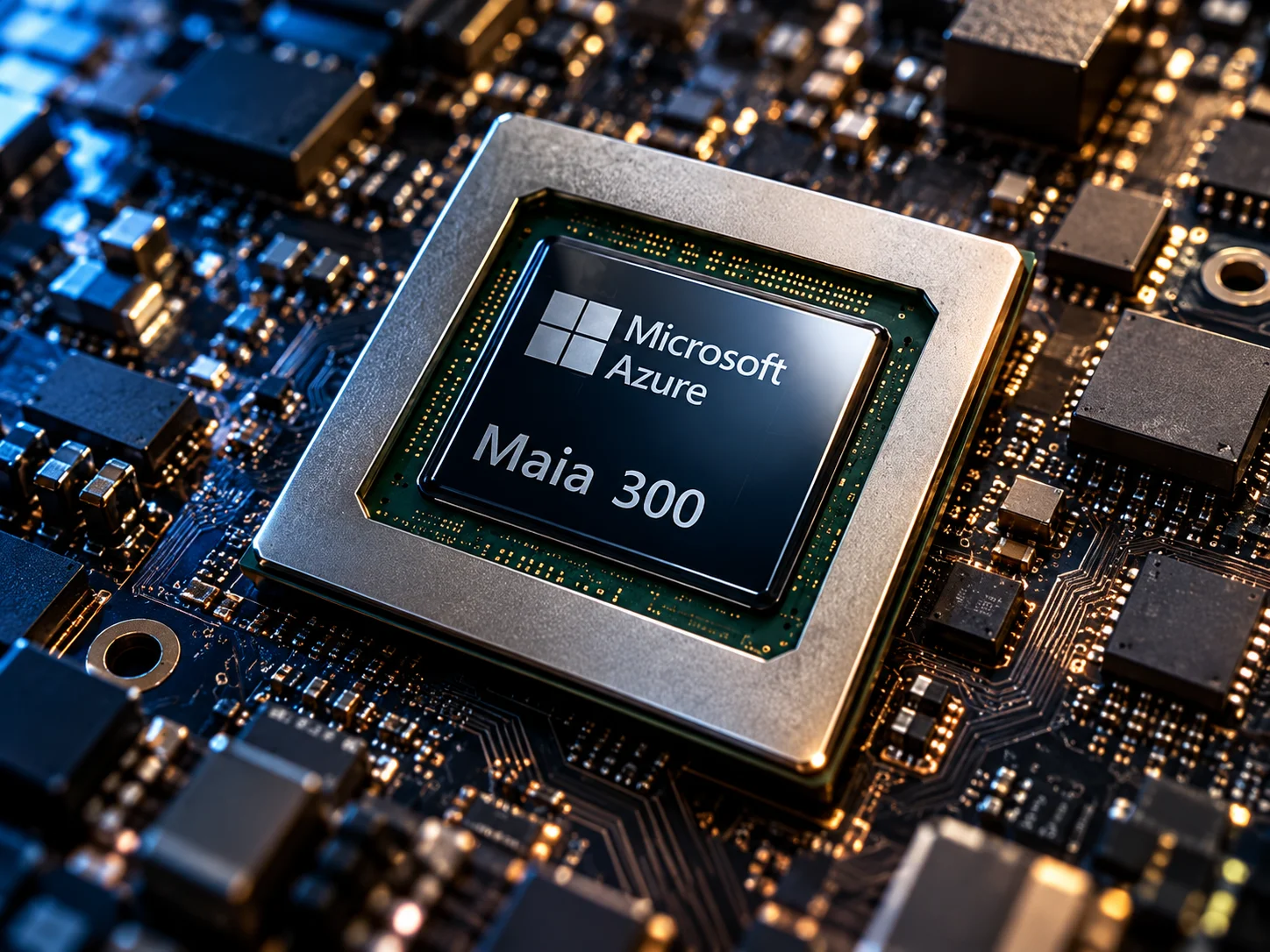
Microsoft unveiled this Monday (12) the Maia 300, the 3rd generation of its own artificial intelligence accelerators. Designed to run AI models at large scale, the system will begin to be deployed in production in 2027, with the goal of becoming the primary inference infrastructure for the company's products and services.
The project brings together 96 accelerators per rack, with projected energy consumption of up to 167 kW and combined capacity of 27.6 TB of HBM memory. The configuration also offers aggregate bandwidth of 1.7 PB/s, intended for the simultaneous processing of large volumes of information.
The Maia 300 was designed especially for inference, the stage in which artificial intelligence models generate responses and perform tasks. Its architecture prioritizes applications that require extensive contexts, low-latency responses and agents capable of performing multi-step operations.
According to Reuters, Microsoft is considering deploying more than one million Maia 300 chips in 2027. The company confirmed plans to expand its Maia infrastructure to facilities with multi-gigawatt power capacity starting next year, but it has not publicly established the one million units as a definitive commitment.
Maia 300 promises 40% more tokens per megawatt, but it does not yet operate in production
Microsoft's main bet is on energy efficiency. The company estimates that the Maia 300 can process 40% more tokens per megawatt than leading GPU-based systems. In a full configuration, it also claims that performance could reach up to seven times the volume of tokens per rack of the Maia 200.
These comparisons, however, do not yet represent independent operational results. Microsoft has not publicly identified which competing systems were used as a reference for the 40% advantage, and the Maia 300 remains out of production.
The difference between projected capacity and actual performance is relevant because the disclosed numbers depend both on the accelerators and on memory, communication between chips and the models run.
In the architecture presented, each accelerator uses eight HBM4 memory modules, with an announced maximum bandwidth of 18 TB/s and a thermal design limit of 950 watts. The processing components are manufactured with TSMC's N2P technology, while different functions are distributed among specialized chips.
At rack scale, the 96 accelerators are organized into 24 modules with four units each, doubling accelerator density compared with the Maia 200.
The previous generation already runs real workloads for products such as Microsoft Copilot, as well as models from OpenAI and Microsoft itself. Its expansion also includes GitHub Copilot and Microsoft Foundry, which are expected to receive support by the end of 2026.
Deployment of the Maia 300 will begin in 2027, but the company has not yet released a detailed schedule for expansion by region nor public results from large-scale operation of the new generation.