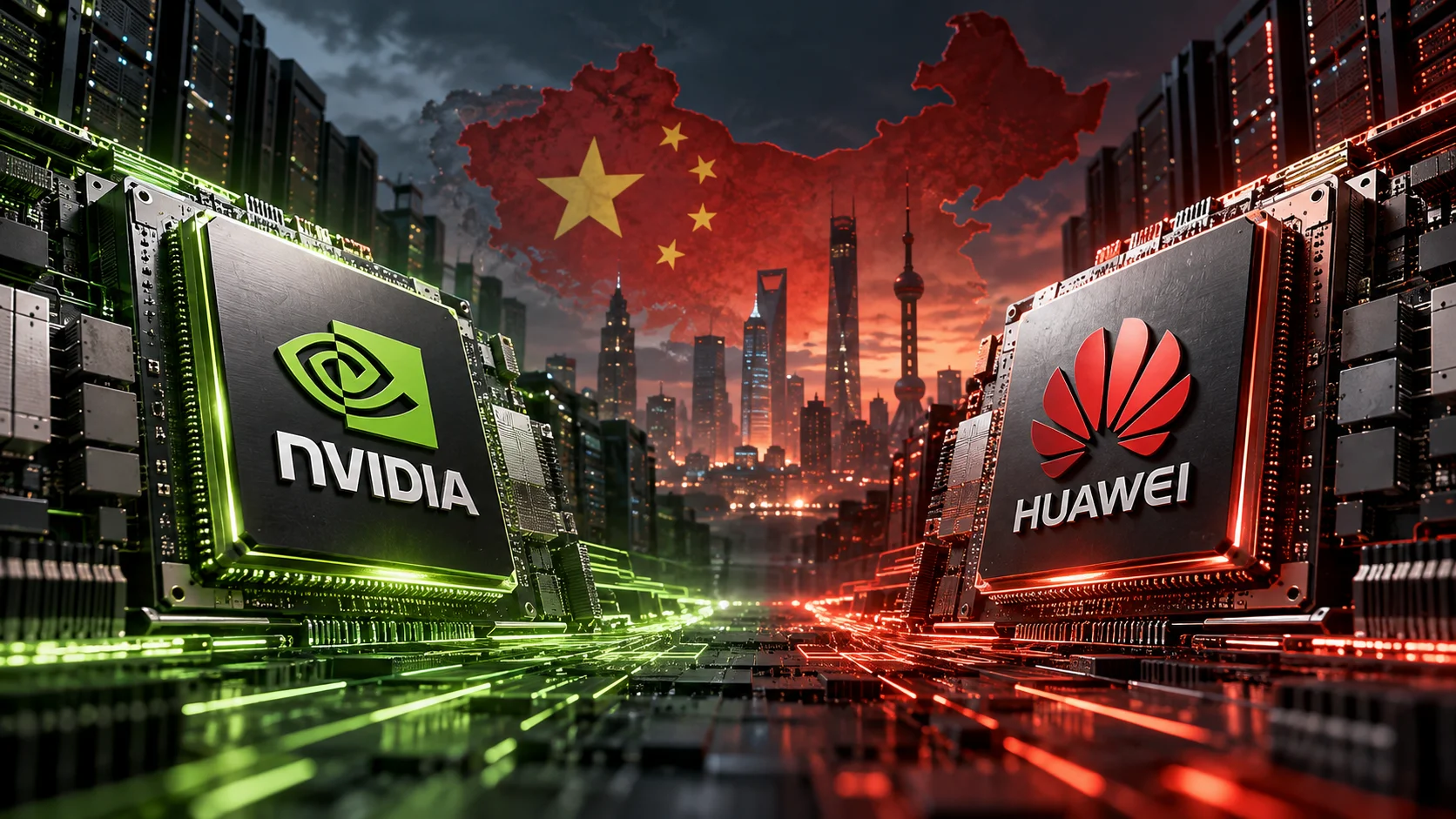
A Nvidia accounted for 34% of the Chinese market for artificial intelligence chips in data centers in the first half of 2026, while Huawei reached 28%. The figures are part of an IDC report obtained by Reuters and released this Tuesday (13), which also reveals a change in the composition of accelerators used in the country.
Between January and June, Nvidia shipped 678,000 AI accelerators to China, a 44% drop from the same period in 2025. Huawei sold 572,000 units, compared with just over 300,000 a year earlier, reducing the gap between the two manufacturers.
The American company's loss of share comes amid export restrictions imposed by Washington, which limit the supply of its most advanced processors. In parallel, Beijing encourages the adoption of domestic alternatives and requires authorization for the import of certain Nvidia chips.
Other Chinese manufacturers also expanded their presence. Alibaba's T-Head division accounted for 7% of accelerators shipped, followed by Cambricon (5%), Baidu's Kunlunxin (4%), and Hygon (3%). Of the 11 Chinese manufacturers tracked by IDC, nine recorded growth in unit volume.
Alternative accelerators surpass GPUs in volume in China
The broader transformation appears in the distribution of processor types. For the first time in the data presented, accelerators that do not use the traditional GPU architecture surpassed GPUs in shipment volume in the Chinese market.
Of the approximately 2 million accelerators shipped in the first half, 1.016 million were alternative chips, growth of almost 80% compared with the previous year. Traditional GPUs totaled 991,000 units, after a 26% contraction.
The alternative segment is dominated by domestic manufacturers. Huawei, T-Head, Kunlunxin and Cambricon accounted for 95% of those shipments, meeting demand from government agencies, internet companies and telecommunications operators.
These accelerators include processors specialized in specific artificial intelligence tasks, such as running already-trained models. GPUs, in turn, continue to be widely used in training AI systems.
The distinction is important because IDC's figures represent units shipped, not computing capacity or revenue. A higher volume of alternative accelerators does not necessarily mean they offer performance equivalent to or greater than that of the most advanced GPUs.
The consultancy also identifies a shift in competition criteria, with greater attention to the performance of complete systems and the ability to operate multiple processors together, rather than evaluating only individual chips.
For 2026 as a whole, IDC projects growth of 19% in the total volume of accelerators shipped to China, even with an estimated 9% drop in GPU shipments. The projections indicate that market expansion may remain concentrated in alternative architectures.